Why Are We Celebrating?
The Feast of Sukkot – A Season of Trust and Dependence
“You shall dwell in booths for seven days. All who are native Israelites shall dwell in booths, that your generations may know that I made the children of Israel dwell in booths when I brought them out of the land of Egypt: I am the Lord your God.” (Leviticus 23:42-43)
I have pitched my tent with a view of the sky, and for one week I will be living in a temporary dwelling place. It does not sound too exciting, and to some it might even sound strange. The question is: why would God command us to sleep in a temporary shelter?
We are coming to the end of the Lord’s prophetic calendar. Let us play a game called “Big Deal, Little Deal.” We will take the three main festivals of the Torah—Passover (Pesach), Pentecost (Shavuot), and Tabernacles (Sukkot)—and ask: What event does this holiday commemorate, and is it a big deal or a little deal?
Big Deal, Little Deal
Passover commemorates the Exodus from slavery, the night we left Egypt. On a scale of 1-10, that is a ten. There are plagues. Blood, darkness, hail, fire. The Sea splits in a climactic moment of triumph. Death to the bad guys; salvation to the good guys. This is a very big deal. It is our Independence Day, the very beginning of our nation.
Shavuot celebrates the moment an entire nation rendezvoused with God and accepted His marriage proposal. On a scale of 1-10, it is like an eleven. The Almighty descended into our world, on top of a mountain, to give us a document that would define our destiny and shape the course of world civilization. Without that event, we would be no more than a nomadic tribe in the wilderness, missing a mission, missing a legacy. That is a really big deal.
Sukkot—what does it commemorate? We sleep in booths because God made us dwell in booths when He brought us out of Egypt. On a scale of 1-10, that sounds like a two and a half. It is nice to sleep in booths, certainly. But do we really need an eight-day holiday for that?
Maybe there is a “big deal” in Sukkot—if we find its missing “event.”
The Missing Event
All the other holidays commemorate a particular event, limited in time, that you can point to. Pesach commemorates the night we went free. Shavuot commemorates the moment we stood at Sinai and received the Torah. But Sukkot seems to break the pattern. It appears to commemorate forty years of booth sleeping—day in and day out. So is it really the case that we have a holiday that does not commemorate an actual event?
Let us return to the verse. We celebrate Sukkot, the Torah says, so that your generations may know that God made the children of Israel dwell in booths when He brought them out of Egypt (Leviticus 23:43).
It sounds like the Torah is talking about a particular point in time. Not forty years in the desert—but right when He brought us out. That first night.
Is this whole booth-commemoration really going back to the very moment of the Exodus?
The First Night in Sukkot
Let us go back to the Torah’s description of those first moments of leaving Egypt:
“And the children of Israel journeyed from Rameses to Sukkot, about six hundred thousand men on foot, beside children.” (Exodus 12:37)
Look at that. Where did they travel to when leaving Rameses? They traveled to a place called Sukkot.
Is that a coincidence? We have a Sukkot holiday that celebrates God causing us to dwell in “Sukkot” when He took us out of Egypt—and right when God took us out of Egypt, the Torah mentions we slept at a place called Sukkot.
When the Torah says God “made us dwell in Sukkot,” the verse may not be referring to what we slept in. Maybe it is referring to a place where we slept: a place called Sukkot.
Why call a place “Sukkot”—the Hebrew equivalent of “shantytown”? Because people made little huts there. In Genesis, Jacob left Laban’s house—his own personal slavery—and came to a place called Sukkot, where he built huts for his cattle (Genesis 33:17).
So in Exodus, the Torah uses shorthand. The Israelites, like Jacob before them, exited slavery and had lots of cattle. The very next thing we hear is that they slept in a place called Sukkot. Obviously, they built sukkot there—little huts for their cattle, just like Jacob. But this time, there were no separate homes for people and cattle. Everyone—cows, sheep, and people—slept in those shanties.
That is what we celebrate. God says: “I made you sleep in Sukkot that first night. That is where I settled you.”
The Momentous Turning Point
Right after that first night in Sukkot, the Torah tells us:
“Now the time that the children of Israel dwelt in Egypt was four hundred and thirty years.” (Exodus 12:40)
Why mention this now? Look at the verse’s first words: “And the settling-downs that the Children of Israel settled down while they were in Egypt were… four hundred and thirty years.”
For four hundred and thirty years, the people had been “settled down.” They had a real roof over their heads. They might have been guests; they might even have been slaves—but they knew that when they went home at night, they had a reliable shelter. They knew where their next meal was coming from.
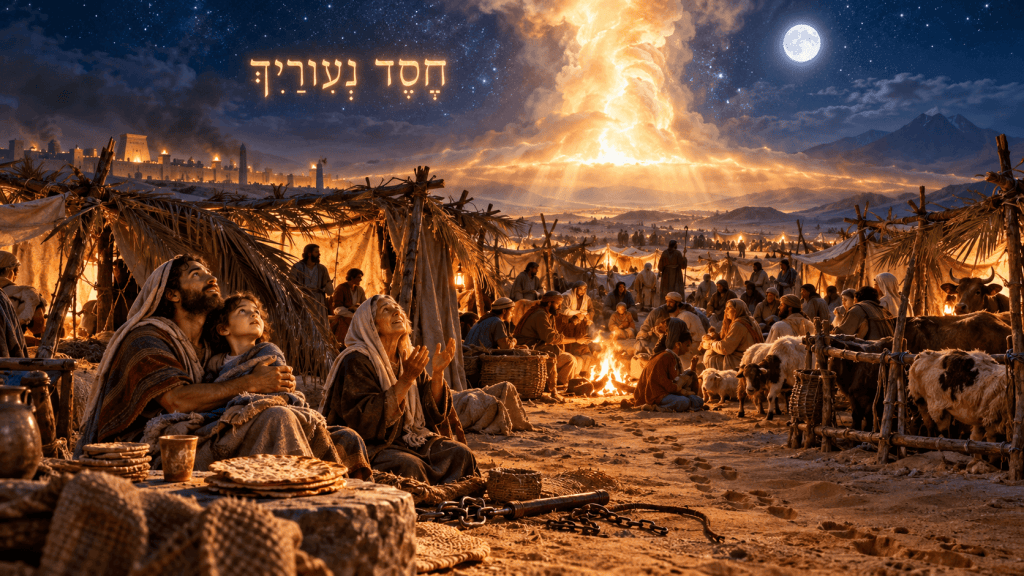
In an instant, all that changed. That first night of freedom, they found themselves sleeping in cattle pens along with the sheep and cows. After four hundred and thirty years of being “settled” in Egypt, they were “settled” by God into little cattle pens in the desert. It changed… in Sukkot.
Stop and think: what must that night have been like?
The Supreme Act of Faith
Here they were, the first night away from Egypt. No master’s lash at their backs. For the first time in generations, they could come and go as they pleased. They could make choices.
On the one hand, it was a dream. But the dream was also terrifying. They were in the desert with nowhere real to sleep. No home to call their own. Sleeping with their cattle. You could almost imagine what was going through their minds: This is ridiculous. What am I doing here?
And the Torah adds one more detail about that night:
“And they baked unleavened cakes of the dough which they brought forth out of Egypt, for it was not leavened; because they were thrust out of Egypt, and could not tarry, neither had they prepared for themselves any victual.” (Exodus 12:39)
Wait—they made matzah that first night? Matzah is a Passover activity, not a Sukkot activity. On Passover, we eat unleavened bread to remember how we rushed out of Egypt.
Something interesting is emerging. There are two holidays—Pesach and Sukkot—that both seem to commemorate the same event: the very first night Israel spent alone in the desert. The only difference is perspective. Pesach remembers what they ate that night. Sukkot remembers where they slept.
The two basic needs of life are food and shelter. They had both in abundance in Egypt. Bread for eating, and a real roof over their heads. They had those necessities—but they were missing freedom. In an instant, everything changed. God caused the Ten Plagues, and suddenly their masters were powerless. They could go free. The question was: would they?
The choice to leave was a supreme act of faith. They placed themselves in the embrace of the Divine and said, “You are inviting us, God, and we are going. Our most basic needs are all now in Your hands.” There was no logistical infrastructure. They had not even packed provisions. There they were that first night, sleeping under the stars, eating their last morsel of half-baked bread, realizing there was no more where that came from. For the first time, they were utterly and totally in God’s embrace.
That was the night these two holidays are celebrating.
A Big Deal for God
What was the big deal about Sukkot? It was earth-shattering—in a quiet, terrifying way. The act of faith is always earth-shattering. The pit in your stomach as you look around and feel all alone, only to realize you are not alone. There is someone else there—and it is God. It is just you and Him. You have left behind everything you took for granted and made the harrowing choice to completely rely on God. If God does not come through, the next night could be your last.
The prophet Jeremiah records God’s own memory of that night:
“Go, and cry in the ears of Jerusalem, saying: Thus says the Lord: I remember the gifts of kindness of your youth, the love of thine espousals; how you walked after Me in the wilderness, in a land that was not sown.” (Jeremiah 2:2)
That night was a big deal for us. And it was a big deal for God. It was the night we gave God the gift of… trust.
The Booths and the Clouds of Glory
The sages focus on Sukkot as celebrating God’s provision for forty years under the Clouds of Glory (Exodus 13:21-22). Are we commemorating the booths we slept in, or the Divine Clouds of Glory? Perhaps both.
That first night, two things happened. We slept in little booths—our human act of faith. But God also did something. He saw us leap into the darkness, vulnerable and unprotected, and He responded. He provided. He sheltered us. He said, “I see your shantytowns, and I will raise you. I will establish for you Clouds of Glory. I will turn your inadequate efforts into miraculous protection.”
We slept in booths, and God protected us with Divine Clouds. Yes—both happened. One view says we commemorate our act of faith. The other says we commemorate God’s act of love. Both are true. We gave God our trust; He gave us His protection.
Why Sukkot Is at the Farthest Point
Why is Sukkot celebrated six months after Passover, at the exact opposite end of the calendar?
The fifteenth of Tishrei is exactly six months after the onset of the Feast of Unleavened Bread. It is the farthest you can get from that first night. And maybe that is because that is when Sukkot is needed most.
The farthest we get from that first night in temporary shelter—when we were a ragtag band of escaped slaves huddled around campfires—is when we are a sovereign nation, in our own land, living in sturdy homes, with the harvest gathered in. It is then, when our home feels like a fortress, that we are most tempted to believe we are self-sufficient.
That is the night we celebrate Sukkot. The harvest is over. We have brought the grain into our homes. Now we are asked to leave our home behind and reoccupy the huts we slept in that first night. In doing so, we recreate the gift of trust.
Even when we have a roof over our heads, indoor plumbing, and Keurig machines, we place ourselves under the Creator’s protection, just as we did then. We do so because a home is little more than a hut; the security it provides is illusory. Real security always comes from God.
A Gift of Love
Sukkot was about a gift of love—a gift of faith we gave to our Creator, and a gift of care He reciprocated. It is these gifts we recreate year after year, so that we never forget the embrace of our Heavenly Protector.
And that is why I am in a tent for eight days starting Tishrei 15. Each of God’s holidays is a prophetic picture. Scripture tells us Yeshua will set foot on the Mount of Olives again on the Feast of Sukkot. It will be the start of the Millennial Kingdom, where He will reign for a thousand years, and those who keep His appointed times will be there for that momentous day (Zechariah 14:16-19). These days of Tabernacles are a shadow of things to come (Colossians 2:17).
Why are we where we are? Because to God it is a big deal—and to you.
“I remember the gifts of kindness of your youth, the love of thine espousals; how you walked after Me in the wilderness, in a land that was not sown.” (Jeremiah 2:2)
May your Sukkot be filled with joy and with God’s presence. Chag Sameach.


Leave a comment