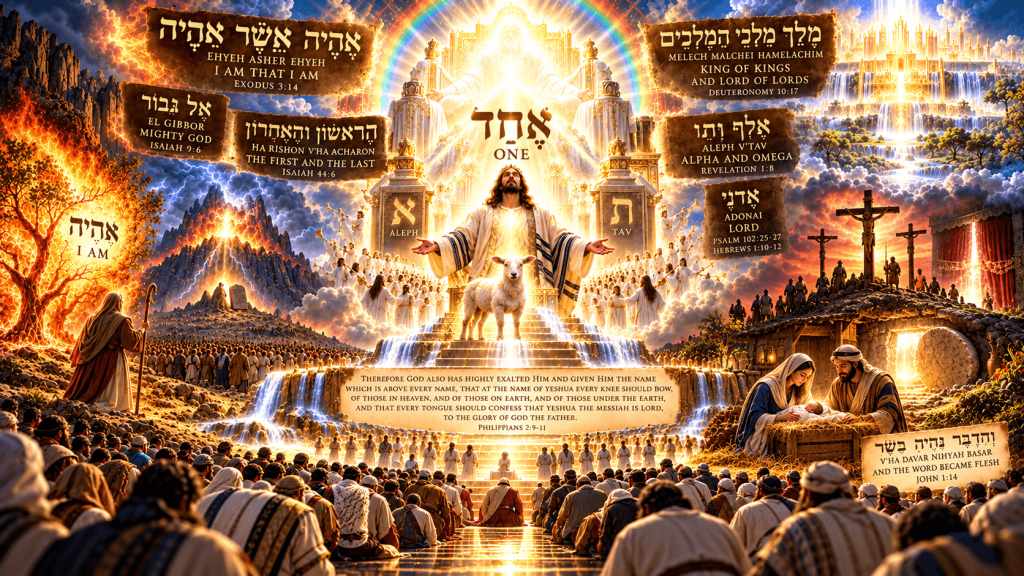
Yeshua and Yahweh Are One
The Identity of the Messiah in Scripture
“In the beginning was the Word, and the Word was with God, and the Word was God… And the Word became flesh and dwelt among us.” (John 1:1, 14)
Over the past couple of years, a topic has been surfacing in the Hebraic community nationwide—a topic debated for the last two thousand years. The question is whether Yeshua is Yahweh/YHVH—God in the flesh.
Many years ago, while studying the beliefs of the Jehovah’s Witnesses, I did a verse-by-verse study through the Tanakh and the New Testament, categorizing verses that indicate Yeshua and Yahweh are one and the same, and verses that indicate the opposite—the distinction between Yeshua as Son and the Father. What I found was that the verses were split almost 50-50.
The traditional Jewish perspective says Yeshua is not Yahweh. The majority of Christian thought says He is. Could it be that there are verses supporting both sides—and that in our zeal to avoid worshiping a man as though he were Yahweh, we have become overzealous in one direction?
Regardless of one’s position, Scripture makes one thing clear: Yeshua is worthy of worship. He is the Redeemer. He is the King. He is the Savior. He is the Word made flesh. He is the Lawgiver. He is the Great I AM. He is the Alpha and Omega—the Aleph and the Tav—who has risen from the dead. He is not only the representative but the complete expression and manifestation of Yahweh in the flesh.
The Common Objection: Representative Authority
The commonly held position is that Yeshua is the representative of Yahweh on earth, carrying the same authority as Him—like an ambassador. My brother Bob was the former Joint Chief of Staff for the state of Colorado. He represented the Governor and wielded the same power as the Governor. But despite that authority, he was not the governor, nor did he claim to be.
Yet Scripture gives us more than representative authority with Yeshua. It reveals that He is Yahweh.
The Names of God
“God” (Elohim/Theos) — The Bible teaches there is only one true God. If the word is used for Yeshua, He must possess true Deity. Consider these passages:
- John 1:1 — “The Word was God.” All major translations say this. If Yeshua is “god” in a lesser sense, we would have two different true gods.
- John 20:28 — Thomas addresses Yeshua: “My Lord and my God!” Yeshua does not rebuke him—He praises him.
- Hebrews 1:8 — The Father says to the Son, “Your throne, O God, is forever and ever.”
- Titus 2:13 — “Our great God and Savior Jesus Christ.” The Greek grammar places one article before two descriptive terms, meaning both refer to the same person.
- 2 Peter 1:1 — “Our God and Savior Jesus Christ.”
“The First and the Last” / “Alpha and Omega” — These terms are used for Yahweh in Isaiah 44:6 and Revelation 1:8. Yet Yeshua uses them of Himself:
- Revelation 1:17 — “I am the First and the Last.”
- Revelation 2:8 — “The First and the Last, who was dead, and came to life.”
- Revelation 22:13 — “I am the Alpha and the Omega, the Beginning and the End, the First and the Last.” The context identifies this speaker as Yeshua (v. 16).
“Lord of Lords” — Used of Yahweh in Deuteronomy 10:17 and Psalm 136:3. Yet Yeshua is called “King of kings and Lord of lords” (Revelation 17:14; 19:16).
“I AM” — God’s name in Exodus 3:14. Yeshua declares in John 8:58: “Before Abraham was, I AM.” The Jews tried to stone Him for blasphemy—they understood exactly what He was claiming.
“Jehovah/Yahweh” — Though this name never appears in the New Testament, Old Testament passages quoted in the New Testament prove Yeshua is called Yahweh:
- Isaiah 44:6 says Jehovah is the first and the last. Revelation 22:13 says Yeshua is the first and the last.
- Psalm 102 is addressed to Jehovah (vv. 1, 12, 15, 16, 18, 19, 21, 22). Hebrews 1:10-12 quotes this psalm and says it was spoken to the Son.
- Isaiah 6 — Isaiah saw Jehovah on His throne. John 12:36-43 says this was fulfilled when Israel rejected Yeshua.
- Joel 2:32 — “Whoever calls on the name of Jehovah shall be delivered.” Romans 10:13 quotes this, and the context shows the “Lord” is Yeshua.
The Characteristics of God
Only God possesses certain characteristics. If Yeshua possesses them, He must be God.
Eternally Existent — Yeshua is not a created being. He is the Creator of all things (John 1:3; Colossians 1:16). His goings forth are “from everlasting” (Micah 5:2). He is called “Everlasting Father” (Isaiah 9:6).
All-Powerful — Yeshua possesses all authority in heaven and on earth (Matthew 28:18). He is able to subdue all things to Himself (Philippians 3:20-21).
All-Knowing — In Him are all the treasures of wisdom and knowledge (Colossians 2:2-3). He knows what is in the hearts of all men (John 2:24-25; Revelation 2:23).
Everywhere Present — He is present wherever two or three are gathered in His name (Matthew 18:20). He promised to be with His disciples always, even to the end of the age (Matthew 28:20).
Unchanging — “Yeshua the Messiah is the same yesterday, today, and forever” (Hebrews 13:8).
Infinitely Holy — He is the Holy One (Acts 3:14; Hebrews 7:26), without sin (Hebrews 4:15).
The Works of God
Only God can perform certain works. Yeshua does them all.
Creating the Universe — All things were made through Him (John 1:3; Colossians 1:16; Hebrews 1:2, 10).
Sustaining the Universe — In Him all things consist (Colossians 1:17). He upholds all things by the word of His power (Hebrews 1:3).
Ruling the Universe — He is King of kings and Lord of lords (Revelation 17:14; 19:16).
Redeeming Mankind — Only God can forgive sins. Yeshua has power on earth to forgive sins (Mark 2:1-12; Luke 7:48-49). He is the Savior of the world (John 4:42).
Judging Mankind — The Father has given all judgment to the Son (John 5:22-23). All nations will be gathered before Him (Matthew 25:31-46).
The Worship of God
Only God deserves worship. Men and angels are forbidden to receive it (Acts 10:25-26; Revelation 22:8-9). Yet Yeshua receives worship:
- A leper worshiped Him (Matthew 8:2).
- The disciples worshiped Him after He calmed the storm (Matthew 14:33).
- The blind man worshiped Him (John 9:38).
- After His resurrection, His disciples worshiped Him (Matthew 28:9, 17).
- Angels are instructed to worship Him (Hebrews 1:6).
He is also worthy of the same glory and honor as the Father (John 5:23; 17:5; Revelation 5:12-14).
Conclusion: Yeshua Is Yahweh
If Yeshua is not God in the flesh, then who is He? He is not a created being. He is not an angel. He is not merely an exalted man. The Bible attributes to Him that which can only be said of God:
- He is expressly stated to be God.
- He is called by names that only God may wear.
- He possesses characteristics that only God can possess.
- He does works that only God can do.
- He deserves worship and honor that only God deserves.
Since there is only one true God, and Yeshua possesses true Deity, He must be included in the one true God—along with the Father and the Holy Spirit.
If Yeshua is God, then He always has been God and always will be God, since God’s nature cannot change. He can limit the use of His powers, as He did on earth as a servant. But He cannot cease to be God.
Yeshua is Deity! Yeshua is Yahweh! Yeshua is God!
“Therefore God also has highly exalted Him and given Him the name which is above every name, that at the name of Yeshua every knee should bow, of those in heaven, and of those on earth, and of those under the earth, and that every tongue should confess that Yeshua the Messiah is Lord, to the glory of God the Father.” (Philippians 2:9-11)
May these truths transform your understanding, deepen your worship, and draw you closer to the One who is and was and is to come.
Read the whole study: Yeshua and Yahweh Are One


Leave a Reply