Made in His Image and After His Likeness
Torah Portion: Bereshit – Genesis 1:1 – 6:8
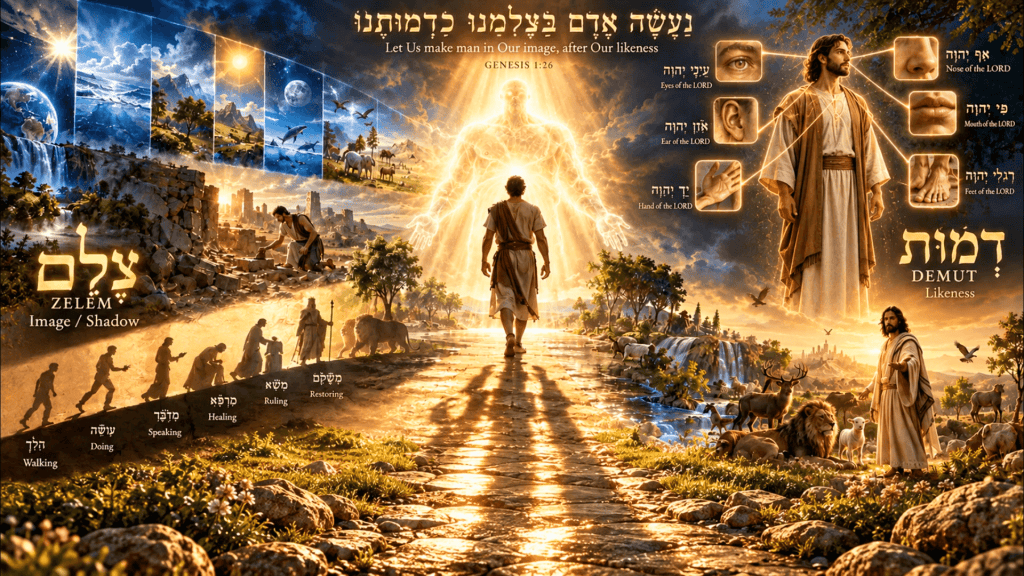
“Then God said, ‘Let Us make man in Our image, according to Our likeness; let them have dominion over the fish of the sea, over the birds of the air, and over the cattle, over all the earth and over every creeping thing that creeps on the earth.’” (Genesis 1:26)
One of the questions that came up recently was this: What does it mean to be made in “Our image” and “after Our likeness”?
There is a great deal in this passage, but we want to focus on the understanding beneath the surface—beyond what a normal dictionary search will give you. Just like the word “name” in Hebrew. In English, the word “name” in Hebrew is shem. But it does not simply mean, “Oh, hi, my name’s Alan.” That is not what Scripture means when it speaks of a name. A name has to do with authority.
For instance, if you pray in Jesus’ name, just because you use the word “Jesus” does not mean you have authority. The apostolic writings make that quite clear. When the apostle Paul was doing ministry in the book of Acts, there were some men who thought they were a bag of chips and a whole lot more. And the spirits said to them, “We know who Yeshua is, we know who Paul is, but you sons of Sceva—we have no idea who you are.” And they beat them. They were using Jesus’ name, but they were not walking in His authority.
It is the same with the concept of “Let Us make man in Our image.”
The Plan and the Action
In Genesis 1:26, it says, “Let Us make man in Our image.” But then in verse 27, it says, “So God created man in His own image.” What is the difference between verse 26 and verse 27?
Verse 26 is the plan. It is the planning process. God said, “Here is what we need to do. We need to make man in Our image, after Our likeness.” Verse 27 is the execution. “God created man in His own image. In the image of God, He created him.”
And then, once Adam was made—male and female—God blesses them and says, “Be fruitful and multiply, replenish the earth”—which tells you there was something there before—”subdue it and have dominion over the fish of the sea, over the fowl of the air, over every living thing that moves upon the earth.”
This is the way God works. God determines what needs to be done. He makes a plan. He puts it into action. And once the action is complete, He blesses the work of His hands with the functional purpose for which that creation was made.
Tzelem: The Shadow of the Form
But in this short teaching, I want to make the distinction between “making man in Our image” and “after Our likeness.”
The word for “image” is tzelem. It means “in the shadow of”—the shadow of the form.
If we were playing with children and said, “Watch my shadow and do everything my shadow does,” my shadow always moves according to how I move. To be created in His image is to be created with the capacity to do what He does.
Now, God obviously does not have eyes—yet “the eyes of the Lord” run to and fro throughout the earth. The Lord does not have ears—yet He hears the cry of His people. The Lord does not have feet—yet He walks in the cool of the day. The Lord does not have hands—yet He saves with His righteous right hand. The Lord does not have a mouth—yet He speaks His word. The Lord does not have a nose—yet He smells the sweet-smelling savor of the offerings.
His hair—He does not have hair, but in the wind it is blowing. He does not have a physical, corporal body. Yet His presence, the way He moves, the way He functions, what He does—that is the word for image: tzelem, shadow. To be something that resembles it. To move as He moves.
The Image of God Is About Restoration
Genesis chapter 1 opens with a creation story that goes into ruin. The ruin then goes through a six-day restoration process, and on the seventh day He rests.
And so the image of God is about restoration. We talked about this when we discussed a brother who is overcome with a challenge and a sin in Galatians 6:1-5. We looked at that in relation to what people often call church discipline, where two or three are gathered in His name to confront a brother.
But the part that everybody misses is this: if I confront a brother one-on-one, what I am telling him is, “I love you so much. I am willing to help you overcome this process—not just to come and warn you, but to walk you through it.” And then two or three witnesses—those two or three people are not there just to say, “Okay, you blew it, so we are going to bring it before the court of the church.”
We miss the boat because we miss God’s image. The image of God is about doing. It is about what God does and moving in His ways.
For instance, when Yeshua said in John chapter 10, “Follow Me,” what does that mean? It means walk where I walk, do what I do, speak as I speak, think as I think, act as I act. That is image. That is the image of something.
Likeness: The Physical Reminder
Now, the likeness is different. Even though God does not have eyes, ears, nose, mouth, hands, shoulders, or feet—He does not have any of those things—what God did was create us in His likeness.
Anthropomorphically, He said, “These are My characteristics that I want you to imitate, but you need physical characteristics to be able to identify with who I am.”
That is why the text in Genesis emphasizes, “Let Us make man in Our image, after Our likeness.” But then in verse 27, “So God created man in His own image. In the image of God, He created him. Male and female, He created them.”
Where did the likeness go? Inquiring minds want to know. But the fact is that whenever I am imitating who God is—walking in His shadow—all the physical components of my being are a reminder. Even though the likeness is left off in verse 27, it is definitely emphasizing that when you think of His image and His likeness, they are not exactly the same. But I am giving you the physical characteristics in your body to remind you that these are the characteristics of Me. And I want you to display those in your life in such a way that the world knows that you belong to Me.
The whole purpose is to rule and reign. He has dominion over everything. But that is another story for another day.
“For whom He foreknew, He also predestined to be conformed to the image of His Son, that He might be the firstborn among many brethren.” (Romans 8:29)
May you walk in His shadow, imitate His ways, and display His likeness to the world.


Leave a Reply