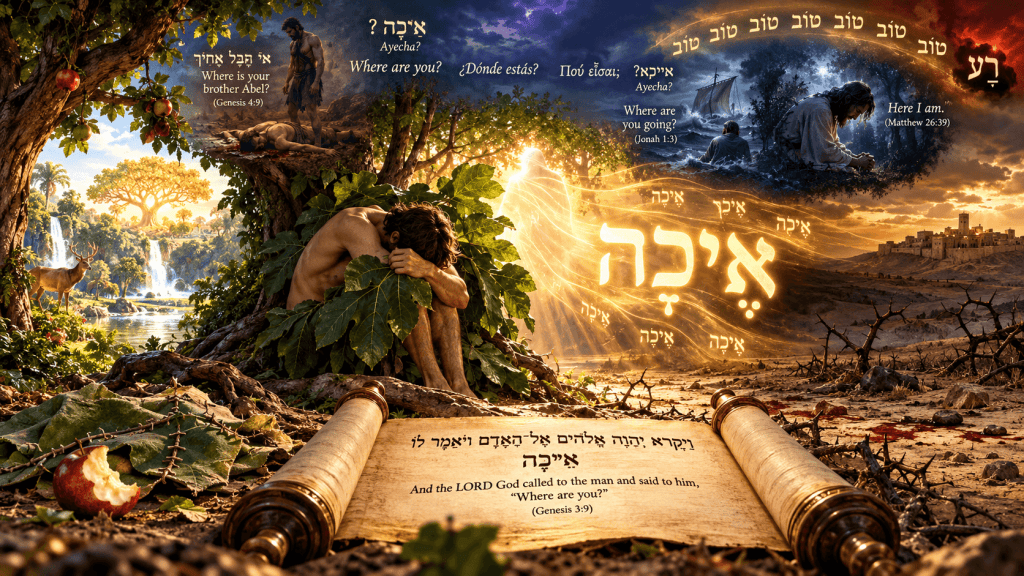
Ayecha: Where Are You?
Torah Portion: Bereshit – Genesis 1:1 – 6:8
“Then the Lord God called to the man and said to him, ‘Where are you?’” (Genesis 3:9)
This past week, we began our venture into the book of Genesis. Many view Genesis as an anthology of moral stories and cautionary tales we learned in Sunday School: “Try to be a good guy, like Moses. Do not disobey God, like Adam and Eve.”
Many of us treat the laws and stories in the Torah as isolated episodes. Week after week, we hear about the laws of sacrifices, the Golden Calf, Joseph and his brothers—and we treat them as isolated events.
But could it be that these are not isolated? Could it be that they are all part of one large story? What if the Torah, like any good book, has a plot—with each story flowing into the next, building to climaxes and resolutions?
God does not come right out and tell us what His book is about. But just because the Author does not spell out the plot does not mean it is not there, waiting to be discovered.
“It is the glory of God to conceal a thing: but the honor of kings is to search out a matter.” (Proverbs 25:2)
Cain and Abel: A Familiar Pattern
Cain had just murdered his brother Abel, and God confronts him: “Where is your brother, Abel?” (Ei Hevel achicha?).
Cain responds with an answer that would resonate for millennia: Hashomer achi onochi—”Am I my brother’s keeper?”
God doles out punishments: “Now you are cursed from the land. When you work the ground, it will not yield its strength to you. You are going to be a wanderer, a nomad.” Cain is exiled from his home. He cries out: “Today you have driven me out from the face of the earth, and now I will be hidden from your face” (Genesis 4:10-14).
Does anything about this remind you of another story in this parsha?
The Echo of Eden
You are correct! The sin of the Tree of Knowledge of Good and Evil.
After Adam and his wife eat from the tree, they hide from God. We just saw hiding in Cain’s story. Cain said he is now hidden from God’s face.
When God asks Adam, Ayeka—”Where are you? How did you get to this point?”—Adam hides from his responsibility and points fingers: “It was the woman’s fault!” And the woman does the same: “It was the snake’s fault!”
But that word, Ayeka—we saw it with Cain: Ei Hevel achicha—”Where is your brother Abel?” And Cain’s response—”Am I my brother’s keeper?”—was shrugging off responsibility. It echoes his parents who pointed fingers.
God curses the ground using the same words He later uses with Cain: “The ground is cursed because of you; in sadness you will eat of it all the days of your life.” And Adam and his wife are expelled from the garden, their home. Cain would also be expelled from his home, forced to wander.
The Parallels Deepen
There is a strong connection between these stories, but the parallels are not identical.
Adam and Eve quibble with God about whose fault the sin was. But Cain does not even acknowledge the sin; he plays dumb before the Omniscient God.
The ground is cursed for Adam, and he will have a hard time working it. But for Cain, he is cursed from the ground. His curse is much worse. The earth will not even produce for Cain at all.
The parallels are there, but they are darker, more severe. Almost as if things are getting worse in the generation after Adam. If the aftermath is similar, the thing that provokes them must be similar too. Cain’s sin must be connected to the sin of the Tree of Knowledge.
But what would that even mean? It looks like the story starts with the sin of the tree—but the story actually starts way at the beginning: Chapter 1, verse 1.
The Meaning of Life
In Genesis Chapter 1, we are introduced to the character of God. He existed before the world was created. And yet, He makes the decision to bring humanity—and everything we need to survive—into the picture.
God goes out of His way for humanity. Each day of creation, God declares that what He has made was good (except day two). It is humanity that stands to benefit from all that goodness.
In chapter 2, God declares that it is not good for man to be alone, and He creates the woman. In the first two chapters we see that it is God who declares the difference between what is good and what is not good for mankind.
God creates the world for man and tells him to be fruitful and multiply and conquer the earth. Which brings us to the million-dollar question: What is the meaning of life?
God does not come right out and tell us. What we can discern is that God’s preparing the world for man was a great act of kindness, establishing the truth that He wants to have a relationship with us.
God gives man everything to enjoy freely, except one restriction—the Tree of Knowledge of Good and Evil. What a strange command—to create something He does not want us to enjoy. And it appears to be an easy command to keep, since man has freely been given everything else.
Yet man still failed. What happened?
The Gift and the Giver
When my children were younger and I gave them a gift, I wanted them to enjoy it, but in the context of the relationship. If my child acted as though they deserved the gift, forgetting who gave it to them, the relationship becomes damaged between the giver and the receiver.
So God says, “Eat from all these trees, enjoy My garden, but I want you to know that it comes from Me because I want to have a relationship with you.” And how do we show that we understand that? By honoring the prohibition not to eat from God’s one tree. That is how we convey our understanding that we are guests in the garden.
We do not make the rules; God does. As long as Adam and his wife realize that, they can have that relationship with God.
But they failed. The temptation was to see yourself as the owner of the garden. If I am a guest, I owe gratitude. It is much easier if it is all mine; I make the rules, not God.
Up until this point, God determined what was good and evil for mankind. When Adam and his wife broke God’s rule, they took good and evil into their own hands. The text says: Vateireh ha’isha ki tov ha’etz l’ma’achal—the woman saw that the tree was GOOD to eat from.
This is the first time a human declares that something is good. The problem is that her perspective on what is good and evil is not God’s. When people decide what is good, it is always tainted by desire. What we WANT becomes good, and what we do not like becomes bad. We forget that we are guests in this world and think that we are the owners, that we should make the rules.
The Curse and the Expulsion
When Adam sins, God responds by cursing the ground He had formed for man. Almost as if God is saying, “I gave you the world to enjoy, and it will produce for you! But if you cannot realize that it is from Me, if you want to pretend that you are the owner and act as God, determining what is good and evil, let us see what you make of it on your own.”
He removed them from the home He built for them, allowing them access to the Garden still, but it was not the same. The intimacy was affected.
Let us go back to Cain. When Cain saw Abel’s offering was accepted and his was not, he got upset. Instead of things getting better, they got worse. But God lovingly reached out to Cain: “Hey, Cain, do not be so angry! If you do what is good (tov), you will be accepted.” There is that word again: Tov. God once again determines what is good.
But Cain has another idea. He heard God clearly, but he took matters into his own hands and, as in the garden, death was the end result. Cain’s fall is further than Adam’s, and the curse is not only on the ground but now on him.
From Seven Tovs to the First Ra
Our opening study of Genesis began with seven Tovs—seven mentions of good—but it ends depressingly with the first time God declares something is Ra (evil).
Vayar Hashem ki rabah ra’at ha’adam ba’aretz v’kol yeitzer machshevot libo rak ra’ah kol hayom—”God saw that the evil of man was great in the land and that all of his thoughts were only evil” (Genesis 6:5).
God became sad and regretted having made man. In the span of just one parsha, we are presented with an ideal world and its rapid decline into destruction.
The Guidebook Back to Relationship
In the parsha Noah, things get worse before they get better, but God has a plan to turn it all around.
The themes we uncovered in Bereshit appear all over the Torah. They present challenges that future generations need to deal with—challenges that maybe even we, in our time, need to deal with. The Torah acts as a guidebook to teach us the way back to closeness in the relationship between God and us.
Our journey through Genesis is a lifelong process. And with every story and every instruction, the question remains the same: Ayecha? Where are you?
Are you living the shame of your past? Are you stuck in the doldrums of life? Are you wearing yourself out resisting the pull of the world? Are you pressing on toward the prize of the high calling in Messiah Yeshua?
We are all somewhere. Where are you, Ayecha?
May you hear the question, answer honestly, and find your way back to the One who is searching for you.


Leave a Reply