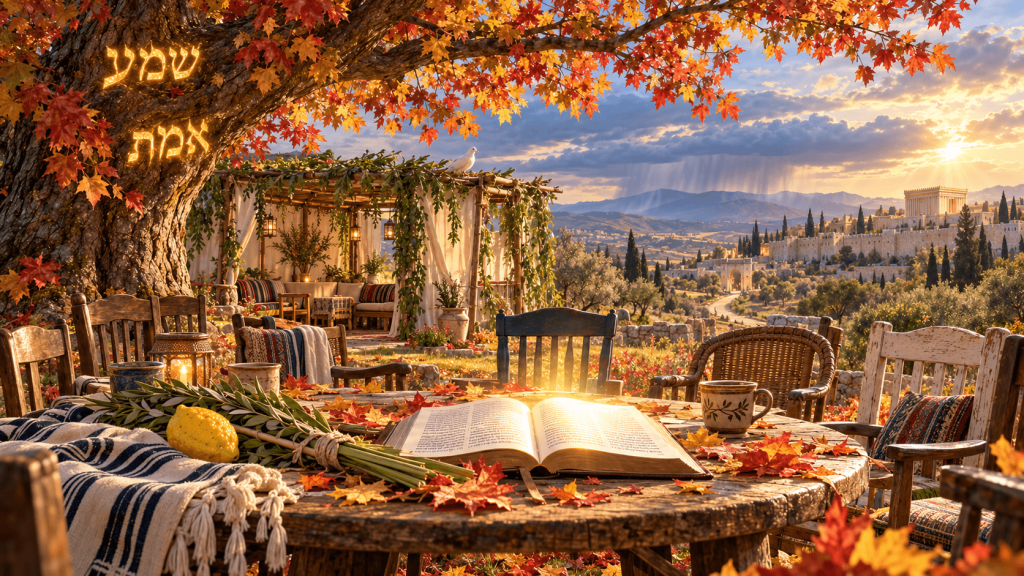
Sukkot and a Call to Listen
The Feast of Tabernacles – Chag Sukkot
“And it shall come to pass that everyone who is left of all the nations which came against Jerusalem shall go up from year to year to worship the King, the Lord of hosts, and to keep the Feast of Tabernacles.” (Zechariah 14:16)
One of the most beautiful realities of the Feast of Tabernacles—also known as Chag Sukkot, the Feast of Booths, the Feast of Ingathering, or the Wedding Feast of the Lamb—is that it is a feast for the nations.
And anytime you get different people together, you are always going to have differing opinions. There is a mindset that says, “Give me two Jews and I’ll show you three opinions.” It is actually kind of funny, but is that not the way we all are? We have an opinion one day, we have an opinion another day; our opinions change like the weather, and when they do, we live our lives fairly confused.
I think everybody is looking for truth. Everybody is looking for answers. Everybody wants to walk in the light that they have been given, and they also want to know what the true light is. We have catchphrases that say, “Jesus is the light of the world.” But what does that really mean? That is a good question, especially since Scripture defines the light as the Word, a lamp unto our feet and a light unto our path. Also in Proverbs 6:23: “The commandment is a lamp, and the Torah is light.”
Confirmation Bias and the Challenge of Listening
As you are starting to warm up to the people around you at Sukkot, you are going to find that people are becoming more open to sharing what they believe, their insights, giving you their opinions.
One thing I have found in my own personal journey is that we all have what are called confirmation biases. We are always looking for answers that defend our already established positions. And though that is easier said than done to get away from, the fact of the matter is, it really is difficult to unlearn what you have already learned.
Depending on how significant your life is in the religious world—whether you grew up in a specific church, whether it is Methodist, Presbyterian, Church of Christ, Nazarene, Baptist, whatever flavor you have been a part of—whatever you have been grown up with is going to be where your belief system is. Anything that is different than that is going to be like, “That’s heresy.”
The question is: at the Feast of Tabernacles, am I open and willing to listen to other people’s opinions? People have a different background. Their stories are different. Their testimonies are different. Their ethnicity is different.
One day, according to Zechariah chapter 14, all of the nations are going to come to Jerusalem, and they are going to worship the King. Yeshua, our Messiah and soon-coming King, is going to establish His throne in Jerusalem. When He does, everybody in the world is going to know it. And they are all going to come up to Jerusalem. And if they do not, then they will not have any rain that comes upon them the next year.
The question is, does that mean physical rain? Does that mean spiritual rain—like the word of God, that is like a soft rain on a tender herb, or like a really strong, penetrating deep-into-the-soil type of rain for grasses and trees that are already established? I guess we will have to wait and see. Between now and then, we have differing opinions.
The Lesson of Micaiah
Look at all the different thousands of denominations just within evangelical Christianity. All of them proclaiming the same book as the authority and the word of God. Some people are King James only. Some people say no. Some people say International Version, American Standard, English Standard. There are more creative ideas out there than you can shake a stick at.
But it is a feast. The question I want to propose to you is: Are you open to listening to the viewpoints of other people that are supported in the word of God? Or are you closed off completely?
The book of 1 Kings chapter 22 ends with the wicked King Ahab, king over the Northern 10 tribes in Israel, the spouse of Jezebel. At times it looks like he is about to make a turn for the better, but he continues with his idolatry; he continues with his Baal worship, and he continues to lead the children of Israel down a path like a group of sheep that have no shepherd.
Ahab is getting ready to go to war between Syria and Israel, and he needs Jehoshaphat, the king in the southern two tribes of Judah, to join him. So Jehoshaphat says, “My horses are your horses, my weapons are your weapons, I am here because I am all about unity.” And so they get ready to join their forces together.
And Jehoshaphat says in verse 7, “Is there not here a prophet of the Lord besides the ones that you have kind of fed at your table—those four hundred prophets that are yes-men, they just do whatever you say? Is there not another prophet?”
And he goes, “Oh yeah, there is yet one man. His name is Micaiah. He is the son of Imlah. And we can inquire of him, but there is a problem. I hate him. He does not prophesy good concerning me, but evil.”
And Jehoshaphat said, “Well, let not the king say so. Let’s get him here and let’s see what he has to say.”
So the king of Israel and the king of Judah, each sitting on their thrones, recognize, “Okay, we need to get some input from this particular prophet.” So a messenger is sent to go get Micaiah, and he speaks unto them the words. And you are right, he does not ever speak anything that fits the preconceived notions of this wicked King Ahab.
Verse 13 says, “And the messenger that was gone to call Micaiah spoke unto him, saying, ‘Behold, now the words of the prophets declare good unto the king with one mouth. Let your word, I pray thee, be like the word of one of them, and speak that which is good.’”
In other words, “Micaiah, if you would, would you just agree with everybody? Don’t be different. Just go along. Everything is going to be fine. Don’t say anything against the way that I already think. I love my confirmation bias because it suits me just fine.”
And Micaiah says, “Well, as the Lord lives, what the Lord says to me, that is what I am going to speak.”
So he comes to the king, and when he does, there is information that comes to him that says, “Micaiah, would you just go along with everybody? Would you just make things good?”
Verse 15: “And he answered him, ‘Okay, go and prosper, for the Lord shall deliver it into the hand of the king.’” And Ahab says to him, “O my stars, how many times am I going to beg you that you tell me nothing but that which is true in the name of the Lord? How often are you going to do that? Every time I am wanting you to do something, you do the exact opposite. And as a result of that, I am telling you, I just do not know what to think about you.”
So then he goes on and he says, “Okay, well, what I am going to do is I am going to just go along with everybody.” And when you continue to read through chapter 22, you are going to find out that the prophet tells the king, “You are in trouble. If you go out there, it is not going to be good for you.”
The Value of Differing Opinions
One of the most challenging things that we face in our life is listening to people that have differing opinions. It is those differing opinions that make all the difference in the world.
I do not want to listen to somebody who everybody agrees with, because the minute I do that is the minute that I am going to just be a yes-man. I do not know if you have ever been around people who surround themselves with people who only agree with what they say.
I jokingly have said over the years that I love to study the rabbis who agree with me. Because you do not have to think, you do not have to change.
One of the most beautiful truths and realities of this feast season is that you have a group of people who have been seeking the Lord over the past 40 days. They have come to Yom Kippur, they have laid out their life, they have said, “Lord, cleanse me, prepare me, give me a fresh slate.” They are celebrating with other people at the Feast of Tabernacles, and they are opening themselves up to varying opinions.
What a beautiful, beautiful truth.
A Call to Listen, Think, Pray, and Search
I am hoping that this holiday season you will be open to listen, to think, to pray, and to search. And as you do, may you have a wonderful, joy-filled season.
The Feast of Tabernacles is a time of gathering. It is a time of celebrating. It is a time of dwelling in booths and remembering the journey. But it is also a time of listening—to the Word, to the Spirit, and to one another.
May we be a people who are not afraid of differing opinions, but who test everything against the Word of God. May we be a people who are willing to learn, to grow, and to be challenged. And may we be a people who, like Micaiah, speak only what the Lord says.
Chag Sameach Sukkot. May your feast be filled with joy, fellowship, and the presence of the King.
“Test all things; hold fast what is good.” (1 Thessalonians 5:21)
May you listen, learn, and rejoice in the Feast of the King. Chag Sameach.


Leave a comment