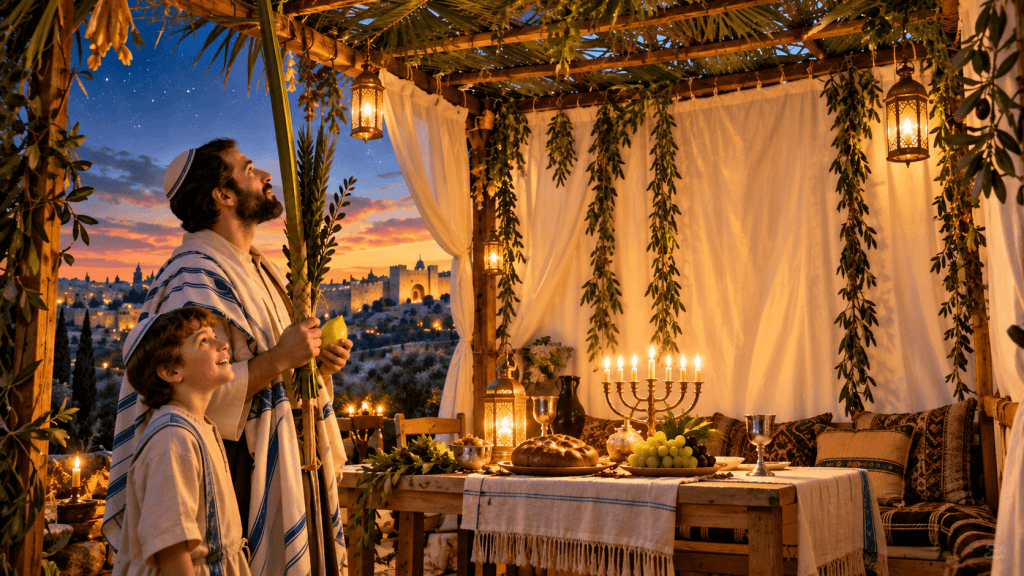
The Feast of Tabernacles
“You shall dwell in booths for seven days. All who are native Israelites shall dwell in booths, that your generations may know that I made the children of Israel dwell in booths when I brought them out of the land of Egypt.” (Leviticus 23:42-43)
After Trumpets and the Day of Atonement comes the Feast of Sukkot, also known as Tabernacles. It is a time of incredible celebration and feasting for the nations.
It requires that the best of the best fruits of the Land are brought for the feasting: the grapes and wine, the wheat, fruits, oils, and livestock. All of these are to be eaten before Yahweh Elohim with the Levites, your family, strangers, widows, orphans, and aliens—all are welcome to taste and see that the Lord is good (Psalm 34:8).
Everyone is invited, and no one is excluded, regardless of tongue, tribe, or nation. Despite the global invitation, there is still room for more (Matthew 22:1-10). Hence, Yeshua continues to stand at the door and knock, desiring to share in the feast with those who have, purposefully or inadvertently, locked Him out (Revelation 3:20). It is a time of incredible hospitality and giving the best you have to the Lord.
That is why Cain’s sin at Sukkot was so grievous (Genesis 4:3-5). He was going through the motions of fulfilling a commandment, but it was not his best.
The Seventh Spirit: The Fear of the Lord
Sukkot is directly connected to the seventh Spirit, the fear of the Lord (Yirat Yahweh). It is directly connected to the church at Laodicea. It is directly connected to the seventh day—the Shabbat. Sukkot is all about the throne of the Most High. It is all about bringing our best into His presence and sharing the best with those who do not have.
It is a time of boundless love. We do not have any resentment toward anyone. Everything is forgiven. Forgiveness has been received and extended. It makes for a wonderful family reunion where everyone gives the best of what they have, and there is no lack.
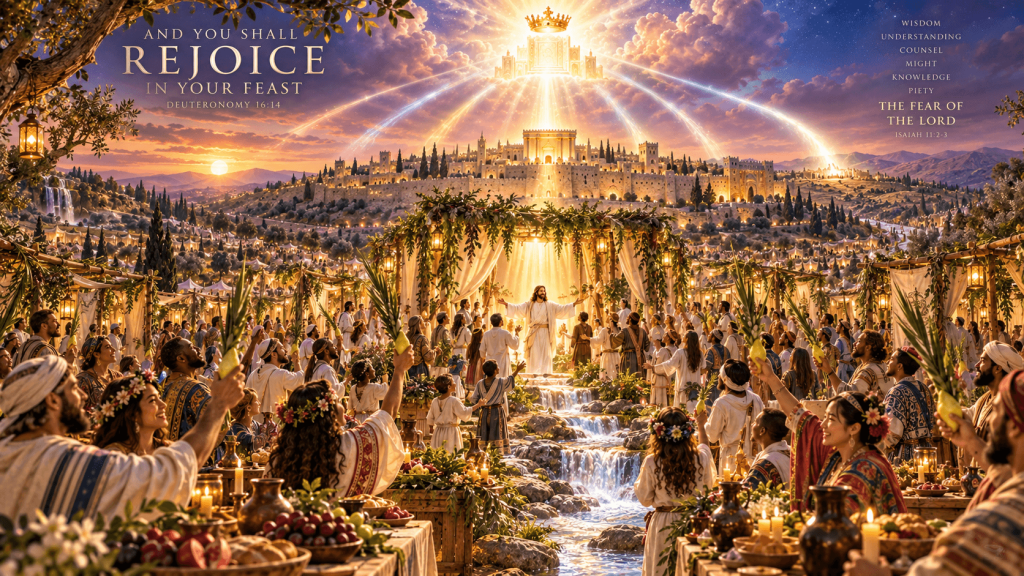
Sukkot is for the nations, which emphasizes the whole duty of man: fear God and keep His commandments (Ecclesiastes 12:9-14). Solomon, in his wisdom, connects all seven Spirits to fearing God and keeping His commandments. He provides wisdom, understanding, counsel, power, knowledge, and fear of the Lord, while keeping His commandments. All of Solomon’s focus is on the King and His righteous rulership. It is all about shifting the authority onto the proper King, ultimately pointing to the coming Messiah (Isaiah 9:6-7).
The Overcomer’s Reward
For those who are constantly striving to live victoriously as overcomers in their walk with the Lord, Sukkot has a wonderful revelation: they will sit on Messiah’s throne, even as He is seated on His Father’s throne (Revelation 3:21).
There is no division at Sukkot, and the commandment to be happy is a reality (Deuteronomy 16:13-15). It is all about unity in the midst of celebrating our diversity (Amos 3:3; Psalm 133:1-2).
There is no overcomer who says, “I am rich and increased with goods and need nothing.” They all humbly admit that they were wretched, miserable, poor, blind, and naked (Revelation 3:17). Sukkot-keepers who have gone through the preparation of the previous six Moedim—Passover, Unleavened Bread, Firstfruits, Pentecost, Trumpets, and Atonement—will have purchased their gold that has been tried in the fire. White raiment will be provided as a covering, because they have anointed their eyes with eye-salve to be able to see Him clearly who is seated on His throne (Revelation 3:18).
Collectively, with the right mindset, each has endured the trials of our faith like gold tried in the fire (1 Peter 1:6-7); by living out the good works of Torah that have been foreordained that we should walk in them (Matthew 5:13-19; Ephesians 2:10; Titus 3:8, 14); and has kept their eyes anointed to the arrival of the King (2 Peter 1:8-10). Each shall receive the prize of the overcomer and find that the whole journey from Passover to Sukkot, under the leadership of the sevenfold Spirit and the restorative pattern of the seven days of the creation story, has been well worth the cost.
A Season of Joy
Sukkot is the final feast of the year. It is a time of dwelling in booths—temporary shelters that remind us of our journey through the wilderness and our dependence on the Holy One. It is a time of gathering with family and community. It is a time of bringing our best offerings before the Lord.
But more than that, Sukkot is a foretaste of the world to come—when all nations will come up to Jerusalem to worship the King, when the tabernacle of God will be with men, and He will dwell with them forever.
This is going to be a special Sukkot. May it be a time of joy, feasting, and drawing near to the Holy One.
“And it shall come to pass that everyone who is left of all the nations which came against Jerusalem shall go up from year to year to worship the King, the Lord of hosts, and to keep the Feast of Tabernacles.” (Zechariah 14:16)
From our house to your house — may your Sukkot be filled with joy, fellowship, and the presence of the King. Chag Sameach / Happy Feasting!
Shalom!


Leave a comment