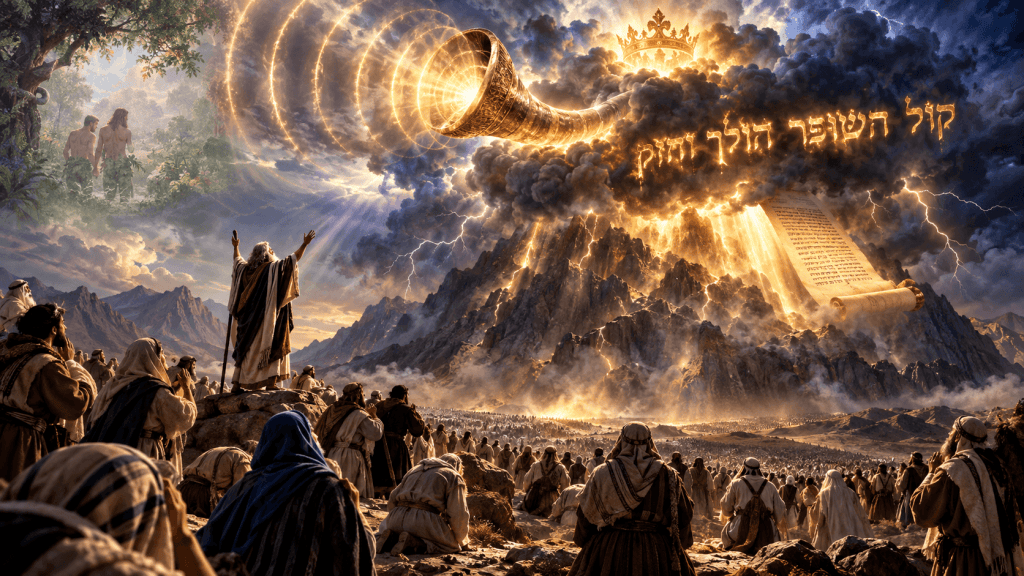
Malchuyot, Zichronot, Shofarot
The High Holy Days are here—Trumpets, Atonement, and Tabernacles. Yom Teruah is known as the Day of Judgment. Yom Kippur is the Day of Repentance and Coverings. Sukkot celebrates a wedding and much more. And though Trumpets is officially over, let us focus again on its themes to carry us to our covering and wedding feast.
There are three themes associated with Yom Teruah:
- Malchuyot — God’s Kingship; crowning the King
- Zichronot — The day of remembrance
- Shofarot — The shofar blast
How are these related to a day of judgment? Go back to the foundation—the first five books.
In Leviticus 23:24, we read of zichron teruah—remembering the cry of the shofar. What event reminds us of the shofar blast? It was at Mount Sinai, when God revealed Himself in a cloud of glory. From the heavens He made His voice heard, and the whole world trembled when the King was revealed on Mount Sinai (Exodus 19).
The Voice That Strolls
How can God reveal Himself in a thick, dark cloud? In a dark cloud, you cannot see anything. At Sinai, Moses reminds them that they did not see anything. There was no vision—only God’s voice of the shofar that grew louder and louder. Eventually that voice coalesced into words, and they heard the Ten Commandments—but before that, it was the voice of the shofar getting louder and louder (Exodus 19:19).
Why would God not allow our sight to take in His presence? Because fragile human beings cannot have that direct experience with the Almighty—they do not last. Men cannot see Him and live. They can only hear His voice.
There is something about a voice that stirs up old memories. When you hear a song from childhood, it transports you back. When an old friend calls out to you, the words do not even matter—you recognize the voice.
Trace His voice all the way back to the garden, when God’s voice was strolling through the cool of the day (Genesis 3:8). Adam and Eve had sinned, they were hiding, they were scared—and then they heard God from afar, and it seemed like the voice was getting louder because He was coming closer.
Now go to Sinai—it seems like the same scene. It is no longer a garden, it is a mountain, and the people were afraid and standing from afar. But it was a good kind of fear; it was awe in the face of the Almighty. And here they were, hearing the voice once again.
In the words of Genesis 3:8: kol ha’shofar holech v’chazeik—the voice was holech, as if it was strolling, as if it was walking. It was going, and it was getting louder and louder, just as it once did in Eden.
Our collective memories were awakened that day, and now every year we have Yom Zichron Teruah—a day of remembering the voice. When we hear the shofar, it takes us back; it stirs something in our collective human souls. We know that voice. It was the moment we made contact. It is the moment that changed everything for us. After that moment, we could never be the same.
Crowning the King
Sinai was the day when we recognized God as our husband; the day we crowned Him as King by stating, “Whatever You tell us to do, we will do” (Exodus 19:8). Here they became a kingdom of priests. There is no such thing as a kingdom without a king. On this day, God became more than a deliverer. He became their Husband and King.
To accept God as King is to accept Him as our leader. It is to follow Him. To let Him lead us and His ways, which we gladly accepted.
There was a context for that acceptance, and it goes all the way back to the first time we heard God’s wordless voice. When we first heard that voice, we hid. We did not heed God’s instructions in the Garden, we felt guilty, we could not face ourselves, and we hid. We wanted to be the rule makers, to determine good and evil. We wanted to be King. But that decision made us uncomfortable in our own skin, so we chose the itchy, milky fig leaves.
But after that sin we got a second chance—a chance to rectify that sin in the form of a voice, the only way God can reveal Himself to humans. After we had eaten from the tree, God approached us. The voice of God was strolling through the garden, coming closer, calling out to us—and that was an opportunity.
We had a choice then. If, instead of hiding, we had acknowledged that we had stepped out of bounds, if we had called out to God and said, “Here I am”—how would history have been different?
The Second Chance at Sinai
Now, at Sinai, God declares: I have taken you out of Egypt and I have brought you on eagle’s wings to Me, and now I have one question for you: im shamo’ah tishme’u be’koli—are you prepared to hear My voice?
Yes, those were the words at Sinai—even before the Ten Commandments. The words before words: are you prepared just to hear My voice? Because if you are, we can rectify the whole disaster that happened when you left Eden. You will understand with that voice who I am: I am your Creator. You will understand who you are: you are the creature in the presence of the Creator.
Will that be uncomfortable? Will you have butterflies in your stomach? Of course you will—it is okay. This is the good kind of fear, the fear that redeems the corrupted fear you experienced in Eden when you were hiding. This is awe, the true product of an encounter between creature and Creator.
So at Sinai there was the sound of the shofar—the voice of God without words—and then just after that, God gave us His ketubah. First we heard His voice; we understood who He was; we understood who we were. He is the Creator, we are the creature.
Memory and Identity
Malchiyot (Kingship) produces challenges, but Zichronot (memory) gives us answers. Memory is the way we understand ourselves. Identity itself is wrapped up in memory. When you remember things, you are connecting the dots between your experiences, weaving them together to form a story. When we remember our lives, we are not remembering disconnected things—we are remembering a story. And our identity emerges from that story.
We speak about Rosh Hashanah as the beginning of the Yomim Noraim—the Days of Awe. What is awe? We feel awe when we are in the presence of something like the Grand Canyon, or when we look up at the stars at night. Why? Because we begin to sense that there might just be a larger story here. And if there is, I have to figure out how I fit. I want to be a part of that larger story.
Yes, the Sinai moment implies Din—judgment. You are going to look at my life; You are going to see my track record. How can I contribute? But that is a glorious thing. It is not judgment to be punitive. No—this judgment is a marvelous opportunity. It is my opportunity to be a part of the grand unfolding story. Take me in.
Matching Voice with Voice
The most powerful thing we can do is to match voice with voice—to give our voice back to the Almighty in the deepest way we can. Not with words, but with something deeper than words: just our voice. This is who we are. That is the shofar.
When we blow the shofar at Trumpets and the final trump at Atonement, we are remembering the cry of the shofar we heard at Sinai; we are showing we remember by echoing that voice. We are matching that voice with a voice that comes from us.
It goes all the way back to Eden. The first time we heard God’s voice, God was reaching out to us. That moment was catastrophic—we hid from the voice, we hid from ourselves. But what could Adam and Eve have done? They could have matched voice with voice. They could have reached out to God with their own voice—not with words. “I hear Your voice, Master. I know who You are. This is who I am. You are the Creator, I am the creature.”
Here is me. The deepest thing I can give You is my voice. Listen to it carefully—in it You will hear that the deepest desire I have is to be part of Your story. You will decide what fits and what does not fit. But take me in; allow me to fit. I want so deeply to be part of Your story.
Nehemiah’s Echo of Sinai
In Nehemiah 8, the people gather together as one in the street in front of the Water Gate. Ezra begins to read the Torah scroll. As the people listen all day, they begin to cry—with good reason. They did not even know what was written in it.
Does this scene bring back memories? A nation gathered as one man, listening to the Torah from one man elevated above the rest? If you guessed Sinai, you win the brownie button.
The people cry because they realize how far away they are from the ideals that the Torah is talking about. They barely even know it is Rosh Hashanah. And so they cry.
Yet they are told not to cry! There is a God out there, a Master, and His story—the story of His purposes, woven through history—that is the Master’s delight. That delight is your strength. You are part of that story, part of that delight. Go home and celebrate. I cannot redo yesterday’s decisions, but today is a new year. A new beginning.
The Torah embodies God’s vision of Tov and Ra’ah, and you want to be part of that vision. If so, walk away from here with strength, with your head held high. You are part of the delight of God, His story—and that is your greatest strength.
This may seem like nothing—your little, apparently insignificant life here—but as part of the Master’s story, it can be a piece of everything. What you are doing here on this little street, in the eyes of the Master, it is a replay of Sinai itself.
The Joy of the Lord Is Your Strength
So here we are, twenty-four centuries after Nehemiah—and what does Yom Teruah mean to us?
Maybe Nehemiah’s words continue to serve us well: Chedvat Hashem hi ma’uzchem—”The delight of God, that is your strength.” God delights in His story and is inviting you to be a part of it.
Trumpets is not a day to be sad; it is not a day to be weighed down with guilt. It is a day to approach the Master with all the genuineness you can muster and say, “This is my voice. I have heard Your voice.
“I remember the shofar blast; it is there in my collective memory. Here is my voice, my most genuine self. I just want to be part of this great story that You are telling. I want to be part of Your delight.
“Can You delight in me? Can You help me find a role? I am just a human being; I feel like nothing in front of You. But I know that through You I can be part of everything.”
And with your rehearsal, you are anticipating the final Yom Teruah, when the Lord will descend from heaven with a shout (Teruah), with the voice of the archangel and the shofar of God, when we will be gathered together as one in the clouds.
“For the Lord Himself will descend from heaven with a shout, with the voice of an archangel, and with the trumpet of God. And the dead in Messiah will rise first. Then we who are alive and remain shall be caught up together with them in the clouds to meet the Lord in the air. And thus we shall always be with the Lord.” (1 Thessalonians 4:16-17)
May you hear His voice, remember the shofar, and crown Him King anew. Chag Sameach.
 Light In Torah
Leave a comment