The Day of Atonement
“For on that day he shall make atonement for you, to cleanse you, that you may be clean from all your sins before the Lord.” (Leviticus 16:30)
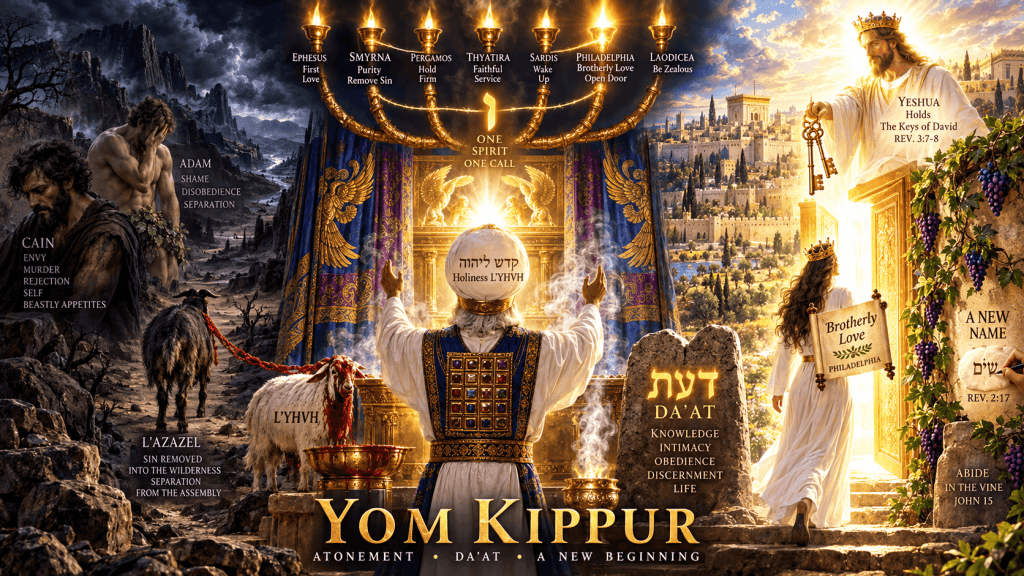
Yom Kippur, the sixth Moedim (God’s Appointed time), is upon us. It carries the Spirit of sacrificial love and knowledge—da’at. It is directly connected to the church of Philadelphia, the church of brotherly love (Revelation 1:20; 3:7). And it connects to the sixth day of creation, which is all about separating our animal, beastly appetites from a life of sacrificial love for our brothers and sisters.
The Day of Atonement is not merely a day of fasting and affliction. It is a day of intimate knowledge—knowing and being known by the Holy One. It is a day when the books of heaven are closed for the next year. It is a day when distinguishing marks are given: those who live da’at and those who live like the beast.
The Spirit of Da’at: The Key to the Holy of Holies
It was through the Spirit of knowledge—da’at—that the High Priest could enter the Holy of Holies on Yom Kippur. The High Priest did not enter by his own merit or by ritual alone. He entered by the Spirit of da’at—the intimate, sacrificial knowledge of the Holy One.
And it is the Spirit of brotherly love, which is da’at, that allows us to dwell at ease in the Temple of the Lord (1 John 4:20). We are welcomed into His presence and firmly established in His Temple—and not only that, we receive a new name (Revelation 3:12).
This is the promise of Yom Kippur. It is not just about forgiveness. It is about transformation. It is about being given a new name—a new identity—that reflects the intimate knowledge we have with our Creator.
Two Goats, Two Destinies: L’YHVH and L’Azazel
The Yom Kippur ceremony in Leviticus 16 describes two goats. One is designated L’YHVH—”to the Lord.” Its blood is brought into the Holy of Holies and sprinkled on the mercy seat. The other is designated L’Azazel—the scapegoat. It is taken into the wilderness, never to return to the camp (Leviticus 16:10).
These two goats represent two destinies. The goat L’YHVH draws near to the presence of God. The goat L’Azazel is sent away, separated from the camp, from the presence, from the people.
In the same way, the High Priest’s turban was inscribed “Holiness L’YHVH” (Exodus 28:36). The mark and name of the overcomer will draw them nearer to His presence (Revelation 3:12).
Cain could not return to the assembly because he hated his brother (Genesis 4:9, 12). He did not live the Spirit of Philadelphia—he did not live da’at. Adam could not return to the Garden because he violated da’at by casting blame on his wife instead of covering her sin (Genesis 3:23-24; 1 Peter 4:8).
Those who live da’at draw near. Those who live like the beast are sent away.
Philadelphia and Smyrna: The Second and Sixth Branches
Yom Kippur and Philadelphia, on the menorah, share a connection with Unleavened Bread and Smyrna (Revelation 2:8-11). The second branch is connected to the sixth. Both deal with removing sin, and both churches clearly separated themselves from sin. Neither is guilty of unclean works.
Smyrna was the church that suffered persecution and remained faithful. Philadelphia was the church of brotherly love that kept His Word and did not deny His name. Both are connected to the work of Yom Kippur: the removal of sin and the purification of the heart.
The Open Door and the New Name
To you who have learned—or are still learning—sacrificial and brotherly love, forgiving one another, providing covering for one another’s sin, there is an open door set before you that no man can shut (Revelation 3:7).
Even though you are weary, you have kept His Word and not denied His name (Revelation 3:8). Your day of recompense with your enemy is coming, and they will know that Yahweh has loved you all along (Revelation 3:9).
Because you have kept the word of His patience, you will be kept from the hour of trial and temptation (Revelation 3:10).
It is not easy—I know it is not. Hang in there, and be careful not to let any man steal your crown (2 John 1:8).
The Spirit of da’at is a deep, mature love that exhibits an awareness of the needs and desires of another. It is shown in restraining words, a controlled spirit, and understanding (Proverbs 17:27). It is a love that covers faults and sins. It does not blame. It repents or grants forgiveness to heal and restore. It always helps and comforts. It produces self-discipline in words and deeds. It intuitively makes relationships good. It sees and seeks the best in others, and it nurtures and cares for the creation.
He modeled it for us at Yom HaKippurim and gives me the opportunity to live it for one another.
A Day of Distinguishing Marks
Distinguishing marks will be given on this day: those who live da’at and those who live like the beast.
The question is not whether we have fasted enough, or whether we have performed the rituals perfectly. The question is whether we have learned to love. Have we learned to cover the faults of others? Have we learned to forgive? Have we learned to draw near to the Holy One with a heart that is soft and yielded to His Spirit?
Yom Kippur is the day of Coverings. It is the day when the High Priest enters the Holy of Holies with the blood of atonement. It is the day when our names are sealed in the Book of Life.
May we be found among those who live da’at—those who love their brothers and sisters, who cover faults, who forgive, and who walk in the Spirit of Philadelphia.
“He who overcomes, I will make him a pillar in the temple of My God, and he shall go out no more. I will write on him the name of My God and the name of the city of My God, the New Jerusalem, which comes down out of heaven from My God. And I will write on him My new name.” (Revelation 3:12)
May you be sealed for a good year in the Book of Life, and may you be found among those who live da’at.
 Light In Torah
Leave a comment