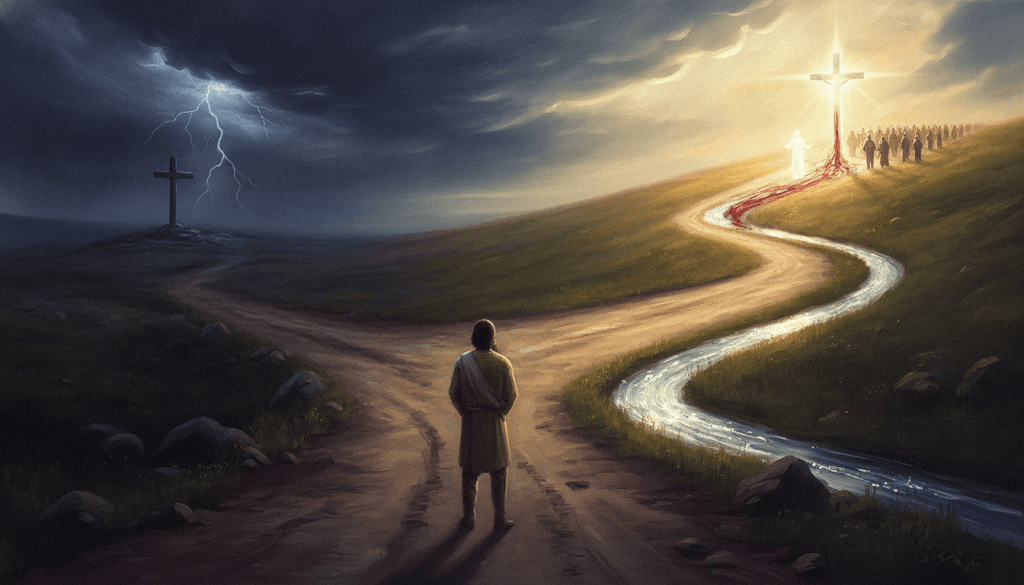
The Cross as Participation, Not Transaction
“For our sake He made Him to be sin who knew no sin, so that in Him we might become the righteousness of God.” (2 Corinthians 5:21)
Most of us have heard the same story. It is the story of penal substitutionary atonement, and it goes something like this:
You are under the wrath of God. Your sin demands a penalty. God’s justice requires payment before He can forgive and show mercy. So He sends His Son to take the penalty in your place. Jesus absorbs the divine wrath, pays the price, takes the punishment that was rightly aimed at you. Because of His blood, you go free. The cross is where God’s anger is finally satisfied, and forgiveness becomes legally possible.
This is the gospel as most people have received it. It is preached from countless pulpits, sung in countless worship songs, and assumed in countless conversations about salvation. But is this the story the Bible has been telling? Or is this a story we have been telling about the Bible and about God?
Two Roads
The first road is substitution. God needed someone to punish. The penalty had to land somewhere, so God aimed it at His Son instead of you. The cross is where divine wrath was finally satisfied, and forgiveness became legally possible.
The second road is participation. God so loved the world that He sent His faithful Son into the place where death had ruled—into sickness, shame, violence, the grave. The Son walked that road faithfully all the way through and emerged with a life death could not hold. He went ahead of us, not instead of us. His life becomes the path we are called to walk.
These two roads do not produce the same disciple. They do not read the same Bible. Substitution ends at the cross. Participation begins at the cross.
What Does “Made Him to Be Sin” Mean?
The substitutionary reading often lands on 2 Corinthians 5:21: “He made Him to be sin who knew no sin, so that in Him we might become the righteousness of God.”
Read with a substitutionary lens, this sounds like a celestial transfer: Jesus is innocent, sin gets imputed to Him, God treats Him as a sinner, the penalty falls, you go free.
But that is not what Paul is doing. For Paul, “made Him to be sin” names full participation, not a transfer.
Consider Romans 8:3: “God sent His own Son in the likeness of sinful flesh and concerning sin, condemned sin in the flesh.”
Read carefully. God did not condemn Jesus. He condemned sin in the flesh. Jesus took on the same human condition that every one of us lives in. He entered the ground where sin had ruled, and from inside that flesh, He condemned the power that had been ruling it.
Substitution says Jesus took something we never had to experience. Participation says He entered the experience we were already in, and from inside it, defeated the power that had been ruling it.
The Vocabulary of Participation
Start with Romans 6: “All of us who have been baptized into Messiah were baptized into His death. We were buried with Him by baptism into death, so that just as Messiah was raised from the dead, we too might walk in newness of life.”
Baptized into His death. Buried with Him. Raised with Him. That language is the opposite of substitution. Substitution says He did it all instead of you. Romans 6 says you died with Him, you walk with Him, you will be raised with Him.
“We know that our old self was crucified with Him” (Romans 6:6). The Greek word synestaurothe means “crucified alongside.” Paul takes that word and turns it into a claim about us: not next to Him, but crucified with Him.
Throughout his letters, Paul uses these “with” compounds: co-buried, co-raised, co-alive, co-heirs, co-sufferers. The vocabulary itself is participatory.
Then Galatians 2:20: “I have been crucified with Messiah. No longer I live, but Messiah lives in me.” “He died, so you do not have to”? No. He died, your old self also died with Him, and you are now called to walk in the life that comes on the other side.
Blood and Water
John 19:34 — the soldier pierces His side, and out comes blood and water. John was not giving a medical detail. He was signaling both directions of participation at once.
Blood — covenant blood. The blood that binds two people together. The blood speaks of the first direction: He participates in us. He enters our condition. He binds Himself to us.
Water — the water of life, from Ezekiel 36, the living water that flows from the believer’s heart. Water speaks of the second direction: we participate in Him. We are cleansed. We become vessels from which living water flows.
He came down into our condition so that we might be raised up into His. The cross is the meeting place. Blood and water. Covenant and cleansing. Participation and transformation.
The Blood of Sinai: Making Priests
When Moses ratified the covenant, he took the blood of sacrifices and sprinkled it on the people, saying, “This is the blood of the covenant” (Exodus 24:8).
What did that blood do? It did not pay a debt. It did not satisfy wrath. It consecrated. It transformed a mob of former slaves into a kingdom of priests. The common became holy. Disciples became priests.
Jesus’ blood does for His people what the blood did for the sons of Aaron: He made priests out of disciples. The cross is not a transaction that settles a legal debt. It is a consecration that transforms a people.
The Cure Before the Wound
The rabbis spoke of the spirit of Messiah as being from before the foundations of the world — the plan, the preordained answer to a wound not yet struck. Peter writes that Jesus was foreknown from the foundation of the world but manifested in these last times (1 Peter 1:20). The cure was in place before the wound.
In the fullness of time, a particular man was born, lived a life of faithful obedience, and at the Jordan, the heavens opened, the Spirit descended, and the voice said, “This is My Son, beloved, in whom I am well pleased.” The spirit that had been waiting from before the foundation took up residence in Yeshua of Nazareth because He had merited it.
From that moment, He confronted the forces of death wherever He met them — the leper, the bleeding woman, the dead daughter, the cross itself. Everywhere death ruled, He stepped in, and life went out. He was not performing a transaction. He was the cure walking.
Who Is This God?
Moses asked to see God’s glory. The Lord passed by and declared: “The LORD, the LORD, a God merciful and gracious, slow to anger, abounding in steadfast love and faithfulness, forgiving iniquity and transgression” (Exodus 34:6-7).
If that is who God is, what kind of cure would He prepare before the wound? A cure that required violence before mercy could show up? A cure that demanded blood before forgiveness was legally possible? Or a cure that entered the wound, carried the sickness, walked through death, and on the other side poured out forgiveness, healing, water, and Spirit on all who would come?
A picture of a wrathful God who needed someone to die before He could love is not the picture Moses saw on the mountain. It is not the picture Jesus gave when He said, “If you have seen Me, you have seen the Father.” Mercy was always how God was going to save. The cross is the faithful demonstration of that mercy, not the price of it.
The Lord’s Table: Participation
If the cross is only a transaction, the Lord’s Table is only a memorial. We remember something that happened long ago. We are grateful, but we are not participants.
But if the cross is the meeting place of two-way participation, the Table is something far greater. Paul writes: “The cup of blessing that we bless, is it not a participation in the blood of the Messiah? The bread that we break, is it not a participation in the body of Messiah?”
The Greek word is koinonia — fellowship, sharing, participation. The cup does not merely point to His blood. It is a participation in His blood. The meal does not point back to a transaction closed 2,000 years ago. It memorializes the accomplishment of His life and points forward into your calling as a disciple.
The Narrow Path
Substitution ends at the cross. Participation begins at the cross. Substitution produces spectators who are grateful for a gift. Participation produces disciples who are called to follow a path.
He went ahead, not instead. His obedience was real. His faithfulness was real. He merited the fullness of the Spirit by walking the path no one else could walk. He confronted the forces of death and overcame them. His life is indestructible. He is the cure prepared before the wound.
Now He turns to us and says, “Follow Me.”
God without us will not — He has chosen to redeem the world through His Son and repair it through the people His Son is gathering. And we without God cannot — we do not have the life, the strength, the new heart on our own. But in Jesus, He has given us everything we need: indestructible life, Spirit poured out, the new heart made real.
We can become because He has gone ahead.
This is the atonement we have been missing. Not God satisfied by punishment, but the faithful Son, the meeting place of heaven and earth, the atonement for our sins and for the whole world.
The cross has not ended your story. The cross began it. Will you follow Him?
“I have been crucified with Messiah. No longer I live, but Messiah lives in me. And the life I now live in the flesh I live by faith in the Son of God, who loved me and gave Himself for me.” (Galatians 2:20)
May you participate in His death, share in His life, and walk the path He has walked ahead of you.
 Light In Torah
Leave a comment