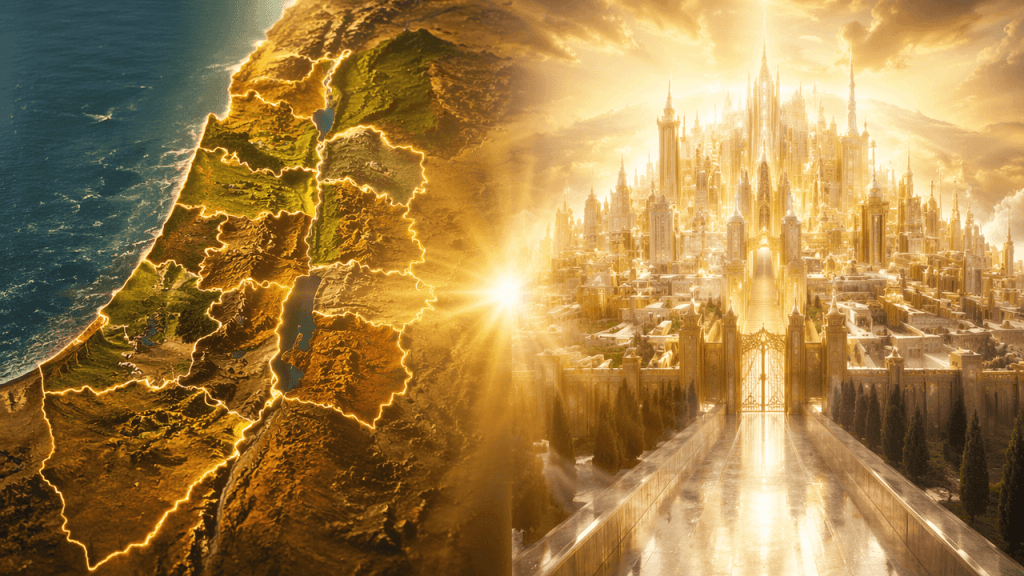
Counting the Cost of the Promised Land
As many of you know, the final book of the Torah is Deuteronomy (Devarim), which means “Words.” Interestingly, there is not a single Torah portion that fails to mention the Land of Israel—either explicitly or prophetically. In fact, about two-thirds of the Torah depend upon Eretz Yisrael, the Land of our inheritance.
The entire focus of the Torah—and ultimately all of God’s Word—is to restore mankind back to the Garden of Eden. And that path leads through Israel and Jerusalem. Every year, I grow more homesick.
But entering the Land requires a focused walk. The Israelites had to be willing to give a good report, no matter what they saw. So do we. Walking in the Word plants the destination of the Word in our hearts: Israel. But first, there must be an accounting. Otherwise, the journey may not go well.
Heshbon: The Accounting
That is exactly how Moses begins Deuteronomy:
“In the fortieth year, on the first day of the eleventh month, Moses spoke to the children of Israel, according to all that the LORD had commanded him to give to them, after he had defeated Sihon the king of the Amorites, who lived in Heshbon, and Og the king of Bashan, who lived in Ashtaroth and Edrei. Across the Jordan in the land of Moab, Moses undertook to expound this law, saying…” (Deut. 1:3–5)
Heshbon means “an accounting”—a balance sheet. Before entering the Land, there is a war on the other side of the Jordan that forces us to check our balance sheet. Just as Israel had to battle the giants of the Rephaim before facing the Anakim in the Land, we too must reckon with what stands in our way.
Moses opens Devarim with a bullet-point history of the wilderness journey, including the grave sin of Tisha B’Av, when the spies gave a slanderous report of the Land even as the door was open. Those who later tried to ascend on their own, without the Lord’s help, were defeated by the Amorites (Emori—”speakers”). Words matter.
Abraham’s Accounting
The Amorite appears throughout the Torah—sometimes as an ally, sometimes as an enemy. Abraham lived among them at Hebron, near the oaks of Mamre, where he was visited by three angels. Interestingly, the Anakim—another class of giants—also inhabited that area, along with the Hittites, from whom Abraham bought the cave of Machpelah for Sarah’s burial.
Why did Abraham have to pay for land that God had already promised him? This was one of his ten tests. The sages teach that God wanted Abraham—and his descendants—to learn that Eretz Yisrael is acquired only through suffering. Before acquiring a plot for the living, one must first acquire a burial plot. To truly strike roots in the Land, one must sacrifice for it. Because the Land is superior both spiritually and materially, the reward is proportional to the pain. And immediately after Abraham buries Sarah, the Torah states, “The LORD blessed Abraham with everything” (Gen. 24:1).
Abraham buried Sarah at great cost, believing in the resurrection. Hebron was said to be the gateway back to the Garden of Eden. Abraham paid a premium for that burial plot because he staked his hope on the future resurrection. So it is with us: we must bury a part of ourselves—our comfort, ego, or security—to gain anything in the Land.
Yeshua and the Cost of Following
This same principle helps us understand Yeshua’s words to His disciples:
“Now when Jesus saw a crowd around Him, He gave orders to depart to the other side of the sea. Then a scribe came and said to Him, ‘Teacher, I will follow You wherever You go.’ Jesus said to him, ‘The foxes have holes and the birds of the air have nests, but the Son of Man has nowhere to lay His head.’ Another of the disciples said to Him, ‘Lord, permit me first to go and bury my father.’ But Jesus said to him, ‘Follow Me, and allow the dead to bury their own dead.’” (Matt. 8:18–20)
Many commentaries say Yeshua was rejecting these men. But perhaps He was doing the opposite. The scribe, a faithful copyist of the Torah, recognized Yeshua as the Messiah. Yeshua warned him that following would mean hardship—leaving his home in Israel to take the Word to the nations. The second disciple was told that following Him meant letting the dead bury their own dead. In other words, burying a part of oneself is required for the journey.
The Storm and the Awakening
When the disciples later crossed the sea with Yeshua, a great storm arose. Yeshua was asleep—a symbol of death. They cried out, and He awoke and calmed the wind and the sea. Even the wind (ruach) and the nations (sea) obey Him. This pairs the spiritual with the natural—the balance sheet of Heshbon. When we cry out in fear of giants or storms, we must remember that the Ark of the Covenant and the Pillar of Cloud that led Israel, not their own efforts. The leadership is divine, but the Israelite must follow and not squander opportunities. Yeshua awoke from the dead precisely for such cries for salvation.
The Land That Drinks from Heaven
“For the land that you are entering to possess is not like the land of Egypt, from which you have come, where you sowed your seed and watered it with your foot, like a garden of vegetables. But the land that you are going over to possess is a land of hills and valleys, which drinks water by the rain from heaven, a land that the LORD your God cares for. The eyes of the LORD your God are always upon it, from the beginning of the year to the end of the year.” (Deuteronomy 11:10-12)
The hallmark of Egypt and the world is that food is easy to predict and obtain. It is easy to maintain only a distant relationship with the Lord because one can prosper without it.
The Land of Israel is not like Egypt. In Egypt, the river irrigates the land, and prosperity can be maintained without deep dependence on God. But Israel depends on rain from heaven—a land of hills and valleys that requires obedience and relationship with the Lord. The eyes of the Lord are always upon it, from the beginning of the year to the end. Israel depends on the inhabitants’ obedience to the commandments. Because one’s natural existence depends so heavily on one’s spiritual relationship with the Lord, one draws closer to Him—obeying Him, seeking Him. Israel is for those who seek that dependency, even when the costs are financial and security-related uncertainties.
What Are You Waiting For?
The ten explorer-spies gave a perfectly accurate report about the Land of Israel. They were right on track—until they added their judgment of whether the Israelites were capable of taking it. The miracles of past generations are ours to remember, but the miracle of where we are now is ours to tell. That we will return to the Land is ours to believe.
The giants in the Land were harmless to Abraham. If we feel small next to the problems in the Land, perhaps it is because we are personally too large to feel small. Part of yourself must be buried to gain anything in Eretz Yisrael—money, ego, family, friends, comfort, safety.
What are you waiting for? Check your balance sheet. Come to Heshbon.
For those among the nations who have repented and returned to the Torah, the ultimate destination is Israel and Jerusalem. Everything they read in the Word hinges on reckoning that destination when the door is divinely open.
Like the scribe, they have no place to go once they have followed Yeshua and the Word. They do not fit in a stagnant church; they do not fit in a synagogue. There is no place to lay their heads. That is okay. We are burying our own dead, sacrificing for this unique calling.
The road of sacrifice eventually leads to Heshbon, Hebron, and Jerusalem. Put it on your bucket list. Pin it.
“Where else would we rather go?”
May your balance sheet be settled, and may you walk through the open door.


Leave a Reply