The Fall Feasts, the Temple, and Our Great God
1 Kings 8 – Yom Teruah and the Season of Repentance
“And all the men of Israel assembled themselves unto King Solomon at the feast in the month of Ethanim, which is the seventh month.” (1 Kings 8:2)
The fall feasts are upon us. It is an exciting time—a time for community, for reflection, and for drawing near to the Holy One. There is not a lot of detail given in Scripture about Yom Teruah. Leviticus 23:23-25 gives us only the sketchiest of details: Zichron Teruah, a remembrance of the blowing of the shofar.
Most of us understand that this takes us back to Mount Sinai, to the time when we made the commitment in covenant agreement—a marriage—to be united with the one true God. Nehemiah chapter 8 is the one passage in Scripture that tells us exactly how to celebrate this wonderful holiday of Yom Teruah. But 1 Kings chapter 8 gives us some incredible insights in relation to the first day of the seventh month.
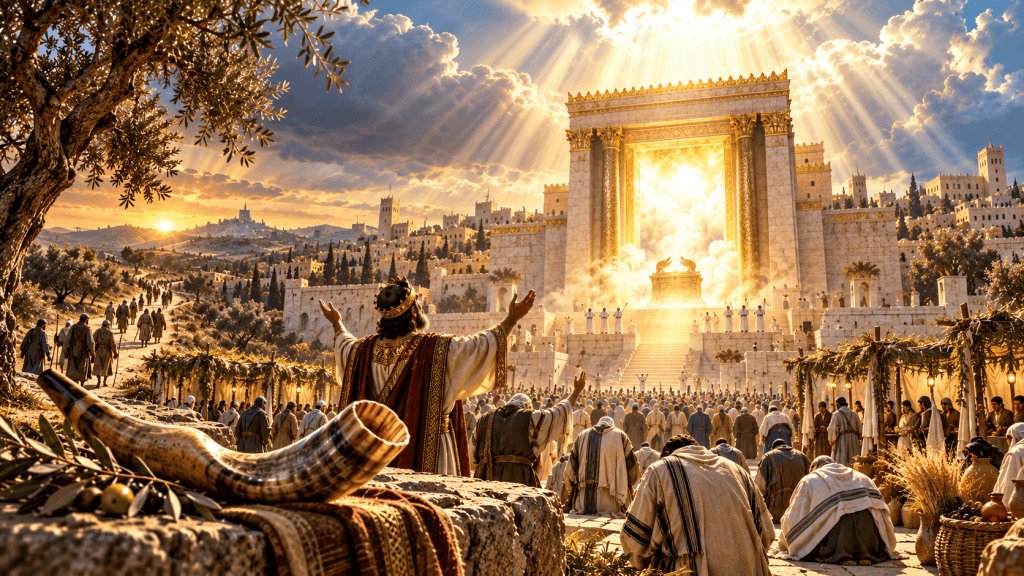
The temple has been built—seven years in the process. The glory of the Lord has filled it. The Ark of the Covenant has been put in its place. And the glory of the Lord has settled into this beautiful structure where God promised that He would dwell in the midst of men.
Solomon’s Prayer: A God Who Constricts Himself
In chapter 8, when Solomon has finished placing the ark in the temple, he offers a prayer to the Lord—a prayer that reveals just how great our God is. Solomon, in his humility, lifts up his hands toward heaven and blesses the Lord as the One who keeps covenant and mercy with His servants who walk before Him with all their heart.
Then he speaks words that reveal his awe and his confusion:
“But will God indeed dwell on the earth? Behold, heaven and the heaven of heavens cannot contain You. How much less this temple which I have built!” (1 Kings 8:27)
Solomon is bewildered. If the highest heavens cannot contain God, how can a building made by human hands contain Him? Yet God had promised—according to the Hebrew concept of tzimtzum, the constriction of the infinite into the finite—that He would confine Himself to a specific place, to His temple.
Solomon did not fully understand, but by faith he built the temple. Seven years of labor. The glory of the Lord filled it. And still, he stood in awe. How could You confine Yourself like this?
A God Who Hears, Forgives, and Restores
Yet Solomon continues: “Yet regard the prayer of Your servant and his supplication, O Lord my God, and listen to the cry and the prayer which Your servant is praying before You today” (1 Kings 8:28).
Here is the wonder of it. God constricts Himself to a place, but He does not remain distant. He gives His attention to His people. He focuses on the temple. He listens when they pray.
And not only does He listen—He acts. Solomon goes on to describe the many situations in which God promises to hear from heaven, forgive, and restore:
- When someone sins against a neighbor, God promises to punish the wicked and restore the righteous.
- When Israel is defeated by enemies because they have sinned, if they turn back to God, He will hear, forgive, and bring them back to the land.
- When the heavens are shut up and there is no rain, if the people confess and turn from their sin, God will hear, forgive, and send the rain.
- When there is famine, pestilence, blight, mildew, locust, or caterpillar—God will hear from heaven and give to every person according to their ways, for He alone knows the hearts of all humanity.
Why does He do this? Verse 40 gives the answer: “That they may fear You all the days that they live in the land which You gave to our fathers.”
The Stranger and the Captive
Solomon’s prayer extends beyond Israel. He intercedes for the stranger—the foreigner who hears of God’s greatness and comes to worship in the temple. God promises to hear and answer, “that all peoples of the earth may know Your name and fear You, as do Your people Israel” (1 Kings 8:43).
And what about those who go into captivity? Solomon knows the pattern of human failure. He knows that Israel will rebel, that they will be carried away captive, that they will find themselves in a foreign land. But even then, there is hope:
“If they return to You with all their heart and with all their soul in the land of their enemies who took them captive, and pray to You toward their land which You gave to their fathers, the city which You have chosen, and the house which I have built for Your name, then hear in heaven Your dwelling place, and forgive Your people who have sinned against You” (1 Kings 8:48-50).
Here is the heart of God: He never stops looking toward Jerusalem. He never takes His eyes off the temple. And when His people—wherever they are—turn back to Him, He hears. He forgives. He restores. He has compassion.
“For they are Your people and Your inheritance, whom You brought out of Egypt, from the midst of the furnace of iron” (1 Kings 8:51).
The Season of Repentance
This is the God we serve. This is the God who calls us His temple. This is the God who established the beauty of the seventh month—the month of repentance, the ten days of awe between Yom Teruah and Yom Kippur, and then the Feast of Tabernacles five days later.
Solomon concludes his prayer with these words:
“Blessed be the Lord, who has given rest to His people Israel, according to all that He promised. There has not failed one word of all His good promise, which He promised through His servant Moses. May the Lord our God be with us, as He was with our fathers. May He not leave us nor forsake us, that He may incline our hearts to Himself, to walk in all His ways, and to keep His commandments and His statutes and His judgments which He commanded our fathers. And may these words of mine, with which I have made supplication before the Lord, be near the Lord our God day and night, that He may maintain the cause of His servant and the cause of His people Israel, at all times, as the matter requires—that all the peoples of the earth may know that the Lord is God, and there is no other” (1 Kings 8:56-60).
Turning Back to God
No matter where you are in this season—whether you are walking in obedience like Solomon, or you find yourself in captivity in this world, or you are living in rebellion and confusion—God wants to make His name known to you.
The fall feasts are an invitation. They call us to teshuvah—to turn back to God. They remind us that He is the God who hears, who forgives, who restores, and who never takes His eyes off His people.
May this season be one of repentance, restoration, and fruitfulness. May we turn back to Him with all our hearts.
Chag Sameach—a joyous festival—for the fall feast season. May the shofar awaken your soul, may Yom Kippur bring you cleansing, and may Sukkot fill you with joy.
“That all the peoples of the earth may know that the Lord is God, and there is no other.” (1 Kings 8:60)
May you be inscribed and sealed for a good year.
 Light In Torah
Leave a comment