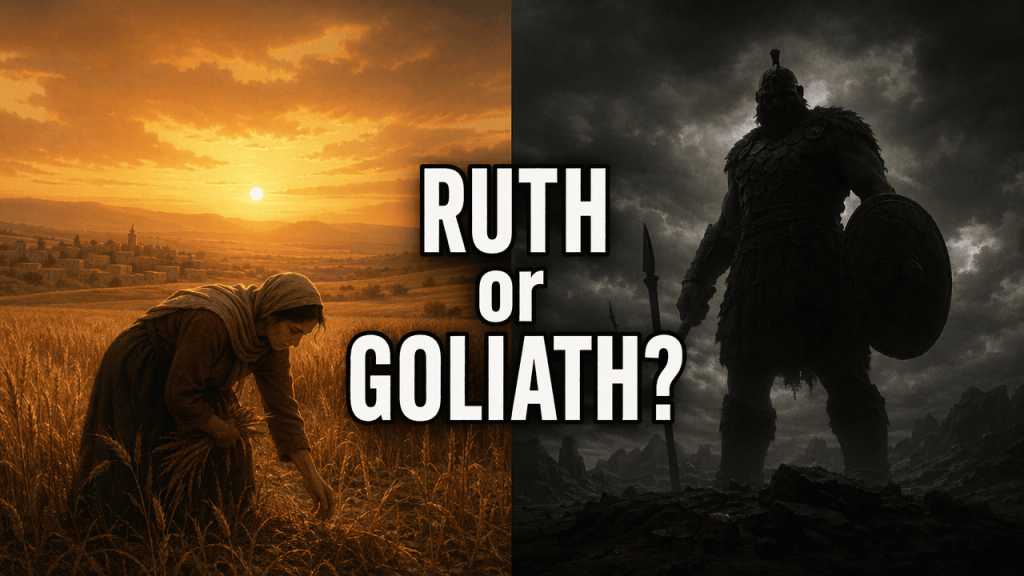
Not the Past, but Your Mindset for the Future Determines Your Destiny
The Book of Ruth
“Blessed be you of the Lord, my daughter: for you have showed more kindness in the latter end than at the beginning, inasmuch as you followed not young men, whether poor or rich.” (Ruth 3:10)
Yesterday was Shavuot. The 50th day. The renewal of the covenant. The outpouring of the Spirit. The waving of the two loaves. But the calendar of the Holy One does not end with Pentecost. There is another count — a count toward the first fruits of the wine, the first fruits of the oil, the first fruits of the wood — all leading to the final feast of the year: Sukkot, the Feast of Tabernacles, the feast when all nations will come up to Jerusalem to worship the King.
And in this season — as we begin a new count, a new preparation — we turn to the book of Ruth. Not because it is merely a beautiful story of loyalty and love, but because it is one of the most prophetic books for the days we are living in. Along with the book of Esther, Ruth provides instructions on how to live in order to obtain the positions that the Holy One is calling us to.
At the heart of Ruth’s story is a powerful truth: It is not your past that determines your destiny. It is your mindset for the future.
Ruth came from a cursed lineage. She was a Moabite — descended from an incestuous union between Lot and his daughter. For ten generations, no Moabite was permitted to enter the assembly of the Lord. By every natural measure, Ruth had no future. She carried the weight of generations of sin. She was widowed, childless, and far from her homeland.
But Ruth refused to let her past define her. She clung to Naomi. She embraced the God of Israel. She gleaned in the fields. She humbly submitted to the plan of the Holy One. And because of her mindset for the future — her determination to move forward, not backward — she became the great-grandmother of King David and an ancestor of the Messiah.
Orpah, her sister-in-law, made the opposite choice. She went back to Moab. She returned to her past. And according to the Babylonian Talmud, Orpah produced Goliath — the giant whom David, Ruth’s descendant, would one day slay.
One woman looked forward and produced a king. The other looked backward and produced a giant. The difference was not their circumstances. The difference was their mindset.
The Backstory: Two Cursed Lineages Coming Together
To understand the power of Ruth’s choice, we must understand the depth of her past — and the depth of Boaz’s past as well. Neither came from a spotless lineage. Both had every reason to be defined by the sins of their ancestors. But both chose to look forward.
Ruth’s Lineage: The Daughter of Moab
In Genesis 19, after the destruction of Sodom and Gomorrah, Lot and his two daughters fled to a cave. The daughters, believing the whole world had been destroyed, decided they needed to preserve their father’s lineage. They took turns sleeping with their father, becoming pregnant by him. The younger daughter named her son Moab — a name that means “from my father.” The Moabites were born from incest. And the Torah declares that no Moabite could enter the assembly of the Lord for ten generations (Deuteronomy 23:3).
Ruth was a Moabite. By birth, by blood, by lineage, she was excluded from the covenant community. She had no right to hope. No right to belong. No right to be blessed.
And yet, she chose to leave Moab. She chose to cling to Naomi. She chose to say: “Your people shall be my people, and your God my God” (Ruth 1:16). She did not deny her past. She did not pretend it didn’t happen. But she refused to let it chain her to the future.
Boaz’s Lineage: The Son of Perez
Boaz came from an equally complicated lineage. In Genesis 38, we read the story of Judah and Tamar. Tamar was married to Judah’s son Er, who died childless. According to the levirate marriage law (yibum), the next son, Onan, was to marry her and raise up seed for his brother. Onan refused, and the Lord took his life. Judah promised his third son, Shelah, but delayed — afraid that Tamar was cursed.
Tamar took matters into her own hands. Disguising herself as a harlot, she seduced Judah, her father-in-law, and became pregnant. When Judah learned of her pregnancy, he demanded she be burned. But Tamar produced Judah’s seal, cord, and staff — the pledges he had given her. Judah confessed: “She is more righteous than I” (Genesis 38:26).
From that union came twins: Zerah and Perez. Perez was born from a relationship that, by any standard, was scandalous. Yet from Perez came Boaz. And from Boaz came David. And from David came the Messiah.
Both Ruth and Boaz came from lines marked by sexual sin, dysfunction, and shame. But neither allowed their past to define their future.
The Threshing Floor: A Test of Character
The climactic scene of the book of Ruth takes place on the threshing floor at midnight. Naomi instructs Ruth to wash herself, anoint herself with oil, put on her best garment, and go down to the threshing floor where Boaz is winnowing barley. After Boaz eats and drinks and lies down, Ruth is to uncover his feet and lie down.
Many commentators have read this scene as seductive — even sexually charged. But that reading misses the entire point of the story. Ruth is not seducing Boaz. She is performing an act of covenantal loyalty. By uncovering his feet — a euphemism for lifting his garment — Ruth is saying: *”I am asking you to be my kinsman-redeemer. I am asking you to perform *yibum, the levirate marriage, and raise up seed for my dead husband.”
This was not seduction. It was supplication. It was a humble request from a woman who had every reason to be ashamed — but who chose to act with dignity, purity, and faith.
The teacher emphasizes: “They recognize the error of the past from which they came. And now what they want to do is to make sure they do it right for the things in the future. That’s their goal. That’s their desire.”
Boaz does not touch Ruth inappropriately. He does not take advantage of her. Instead, he blesses her: “Blessed be you of the Lord, my daughter: for you have showed more kindness in the latter end than at the beginning, inasmuch as you followed not young men, whether poor or rich” (Ruth 3:10). He recognizes that Ruth could have pursued any young man. But she chose to pursue the path of covenantal faithfulness — the path that honored her dead husband, her mother-in-law, and the God of Israel.
Boaz sends her home with six measures of barley — a sign of provision, a promise of redemption. And Naomi tells Ruth: “Sit still, my daughter, until you know how the matter will fall; for the man will not be in rest until he have finished the thing this day” (Ruth 3:18).
Ruth did not manipulate. She did not scheme. She did not seduce. She simply placed herself in the path of the redeemer and waited. And Boaz, the man of integrity, did the rest.
The Gate: The Nearer Kinsman Refuses
The next morning, Boaz goes to the city gate — the place of judgment, the place of legal transactions. He gathers ten elders. He presents the case to the nearer kinsman: Naomi is selling a piece of land, and the kinsman has the right of redemption.
The nearer kinsman initially agrees to redeem the land. But then Boaz adds: “On the day you buy the land from Naomi, you also acquire Ruth the Moabite, the widow of the dead, in order to raise up the name of the dead on his inheritance” (Ruth 4:5).
Suddenly, the cost changes. The nearer kinsman realizes that redeeming the land also means marrying Ruth — and raising up a child who will not carry his own name, but the name of the deceased. He says: “I cannot redeem it for myself, lest I impair my own inheritance. You take my right of redemption, for I cannot redeem it” (Ruth 4:6).
The nearer kinsman is never named. He represents those who are unwilling to pay the cost of redemption. He is willing to take the land — but not the bride. He is willing to receive the inheritance — but not the responsibility. He walks away. And Boaz steps in.
This is a picture of the Messiah. Yeshua was willing to take the bride — even at great cost. He was willing to raise up seed for the dead. He was willing to redeem not just the land, but the people. The nearer kinsman refused. But Boaz, the faithful redeemer, did not.
Orpah and Ruth: Two Choices, Two Destinies
One of the most haunting details of the book of Ruth is not found in the book itself — but in the Babylonian Talmud. The teacher shares this tradition: Orpah, who chose to return to Moab, eventually married a man and gave birth to four sons. One of those sons was Goliath — the giant whom David, the descendant of Ruth, would later slay.
Think about this. Ruth produced David. Orpah produced Goliath. The woman who looked forward produced the king who defeated the giant. The woman who looked backward produced the giant who was defeated.
The text does not tell us this — but the tradition underscores a profound truth: Your choices have consequences that ripple through generations. Orpah chose to go back to her past, back to her gods, back to her people. That choice produced an enemy of God’s people. Ruth chose to go forward, to cling to Naomi and to the God of Israel. That choice produced a man after God’s own heart.
The teacher says: “It’s not your past that counts. Oh, that’s why you are where you are. It’s what you’ve got for the future and where you’re looking for the future. And what you want to do is you want to produce a David that kills a Goliath.”
Your past does not have to determine your future. The failures of your ancestors do not have to be your failures. The curses of your lineage do not have to define your destiny. You can choose to look forward. You can choose to cling to the covenant. You can choose to glean in the fields of the Redeemer. And from that choice, you can produce something that defeats the giants of your generation.
Ruth as a Prophetic Picture: The Grafted-In Bride
The teacher emphasizes that the popular interpretation — Ruth as the church and Boaz as Christ — is not accurate. Instead, Boaz represents God the Father, and Ruth represents the obedient Gentile who has been grafted into the olive tree. The child born from their union — Obed — is a picture of the Messiah.
This is a profound reorientation. Ruth is not the bride of Christ in this typology. She is the faithful foreigner who is brought into the covenant people and becomes the vessel through whom the Messiah comes. She is the one who leaves behind her past, her gods, her homeland, and her family — just as Abraham did — to follow the God of Israel.
And in doing so, she receives a new identity. She is no longer defined as “Ruth the Moabite.” She becomes “Ruth, the great-grandmother of David, the ancestor of the Messiah.” Her past is not erased, but it is redeemed. The curse of Moab is swallowed up by the blessing of covenant faithfulness.
This is the hope for every believer who has been grafted into the olive tree. You may come from a background of sin, dysfunction, and shame. You may carry the weight of a cursed lineage. But when you cling to the God of Israel — when you say, “Your people shall be my people, and your God my God” — you are given a new future. You become part of the story of redemption. You become an ancestor — spiritually speaking — of the Messiah.
Practical Application: Setting Your Mind for the Future
As we begin this new count — the count toward the first fruits of the wine — consider these questions:
1. Are you defined by your past? Do you carry shame from your own failures or the failures of your ancestors? Do you believe that your past disqualifies you from the purposes of God? Ruth’s past did not disqualify her. Neither does yours.
2. Are you looking backward or forward? Orpah looked backward and produced a giant. Ruth looked forward and produced a king. The direction of your gaze determines the direction of your destiny. Are you fixated on what was — or are you anticipating what will be?
3. Are you willing to glean in the fields? Ruth did not wait for redemption to fall from the sky. She went out to the fields. She gleaned. She worked. She humbled herself. Redemption came through her daily obedience. Are you willing to do the small, faithful tasks that position you for the great redemption?
4. Are you willing to wait on the redeemer? Ruth lay at Boaz’s feet until morning. She did not rush. She did not manipulate. She trusted. Naomi told her: “Sit still, my daughter, until you know how the matter will fall.” Waiting is not passivity. It is active trust. Are you willing to sit still until the redeemer acts?
5. What legacy are you producing? Orpah produced Goliath. Ruth produced David. The choices you make today will produce a legacy for tomorrow. What kind of legacy are you building? Are you producing giants that need to be slain — or kings who will slay them?
Conclusion: The Harvest Is Waiting
The book of Ruth is set during the barley and wheat harvest — the season of Shavuot, the season of Pentecost. Ruth gleaned in the fields at the very time the covenant was being renewed. And because she positioned herself in the harvest, she was found by the redeemer.
We are in a new harvest season. The fields are white. The Lord of the harvest is calling laborers. And He is calling you — not because your past is perfect, but because your future is bright.
Do not look back at Moab. Do not return to the gods of your ancestors. Do not let the curse of your lineage define your destiny.
Look forward. Cling to the God of Israel. Glean in the fields of His grace. And watch — with patience, with faith, with humility — as the Redeemer comes.
For He will not rest until He has finished the thing this day.
Shalom.
“Forgetting those things which are behind and reaching forward to those things which are ahead, I press toward the goal for the prize of the upward call of God in Messiah Yeshua.” (Philippians 3:13-14)
May you produce a David, not a Goliath, and may your legacy be written in the book of the King.
 Light In Torah
Leave a comment