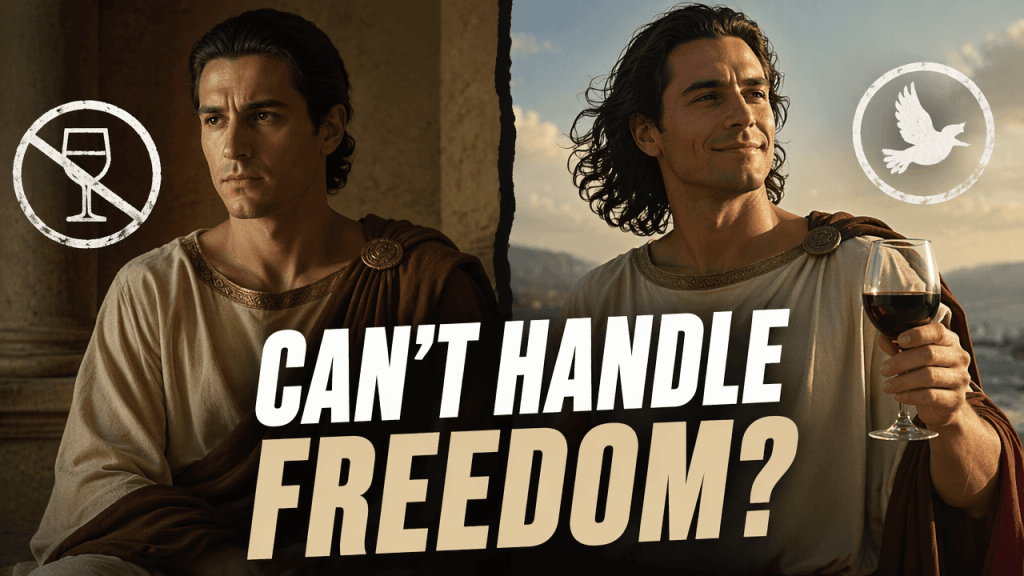
When You Can’t Handle Freedom
Torah Portion: Naso (Numbers 4:21 – 7:89)
“Speak to the children of Israel, and say to them: ‘When either a man or woman consecrates an offering to take the vow of a Nazirite, to separate himself to the Lord…’” (Numbers 6:2)
We are two days from Shavuot. The 48th day of counting the Omer is behind us. The anticipation is building. The covenant is about to be renewed. The Spirit is about to be poured out. And in the midst of this preparation, the Torah portion Naso presents us with one of the most curious and misunderstood institutions in all of Scripture: the Nazirite vow.
A man or a woman voluntarily takes a vow to separate themselves to the Lord for a period of time. During that time, they must abstain from three specific things:
- Anything from the fruit of the vine — wine, grapes, raisins, even vinegar made from wine.
- Cutting their hair — the locks of their head must grow long.
- Contact with any dead body — even the body of a father, mother, brother, or sister.
At first glance, this seems like a super-spiritual act. The Nazirite appears to be pursuing a higher level of holiness, a more intense devotion to God. But is that really what the vow represents?
The teacher offers a startling interpretation: The Nazirite vow is not for the spiritually strong. It is for the spiritually weak. It is for those who cannot handle the freedom that God has given them.
The Freedom of the Torah: What God Permits
The Torah is not a list of arbitrary restrictions. It is a gift of liberation. It defines the boundaries within which we can live freely, joyfully, and abundantly.
Consider what the Torah permits:
- The fruit of the vine. The Torah does not forbid wine. In fact, wine is associated with celebration, joy, and blessing. Psalm 104:15 declares that God gives “wine that makes glad the heart of man.” Yeshua’s first miracle was turning water into wine at a wedding feast (John 2). The Passover seder includes four cups of wine. Wine is not a sin. It is a gift — to be enjoyed in moderation, with gratitude, never to excess.
- Cutting hair. The Torah does not forbid haircuts. The priests were required to keep their hair trimmed. Even the Nazirite, at the conclusion of his vow, shaves his head completely. Hair is not inherently holy or unholy. It is a matter of personal choice.
- Contact with the dead. The Torah commands honoring father and mother. When a parent dies, it is a mitzvah to participate in their burial and mourning. The priests were restricted from contact with the dead because their service was entirely focused on life. But for the ordinary Israelite, caring for the dead is an act of lovingkindness.
The Torah gives freedom in all these areas. The Nazirite voluntarily gives up that freedom — not because the Torah requires it, but because he cannot handle it.
The teacher explains: “If God’s permitting you to do something, but you can’t do those things without falling into a temptation that’s related or unrelated, then what you’re doing is the things that God says you’re free to do. You’re saying, I don’t want to do those because I’m struggling so much on my inside that I need to revamp my whole thought pattern.”
The Nazirite is saying: “I can’t handle the freedom that God gives me. I need extra boundaries. I need to build a fence around the Torah. I need to restrict myself from things that are permitted because I am not yet strong enough to enjoy them without stumbling.”
This is not a higher level of spirituality. It is an admission of spiritual weakness.
The Nazirite and the Priest: A Comparison
The restrictions of the Nazirite vow closely mirror the restrictions of the priesthood. The priests, when serving in the tabernacle, were forbidden from drinking wine or strong drink (Leviticus 10:9). They were forbidden from coming into contact with the dead (Leviticus 21:1-4). But there was one key difference: the priests were required to keep their hair trimmed. They could not let their locks grow long like the Nazirite.
The Nazirite, by letting his hair grow, was making a statement: “I am not a priest. I am not called to this permanently. I am taking on these restrictions temporarily because I need them.”
The teacher notes: “He’s going to get to enjoy some of the restrictions of the priesthood, to feel connected to the priesthood, but yet his hair is going to grow long and it won’t be able to be cut.”
The Nazirite vow is a temporary crutch, not a permanent state of holiness. It is a recognition that the one taking the vow is not yet ready to walk in the full freedom of the Torah. He needs a period of separation, of extra boundaries, of intensified discipline, so that he can eventually return to the freedom that God intends.
The End of the Vow: Freedom Restored
The most surprising aspect of the Nazirite vow is its conclusion. After the days of separation are fulfilled, after the offerings are brought, after the hair is shaved and burned on the altar — what happens next?
“After that, the Nazirite may drink wine” (Numbers 6:20).
The very thing he could not do during the vow, he is now permitted to do. The restriction was never permanent. It was never intended to be a lifelong state. It was a temporary measure for a temporary weakness.
Once the Nazirite has completed his period of separation, he is restored to full freedom. He can drink wine again. He can cut his hair. He can attend the funerals of his loved ones. The crutch is no longer needed. He has grown strong enough to handle the freedom that God always intended for him to enjoy.
This is the opposite of what many people assume about spiritual growth. We tend to think that the more spiritual we become, the more restrictions we will embrace. But the Torah teaches the opposite: the more spiritual we become, the more we are able to handle freedom. The goal is not to live perpetually under extra-biblical restrictions. The goal is to mature to the point where we can enjoy all that God has given us without stumbling.
The Nazirite in the New Testament: Paul’s Vow
The Nazirite vow appears in the New Testament in a surprising place. In Acts 21, the apostle Paul returns to Jerusalem. The leaders of the Jerusalem assembly inform him that a rumor is spreading: Paul is teaching Jews living among the Gentiles to forsake Moses, to stop circumcising their children, and to abandon the customs of the Torah.
This rumor was false. Paul himself had taken a Nazirite vow earlier in Acts 18: “Paul after this tarried there yet a good while, and then took his leave of the brethren, and sailed thence into Syria, and with him Priscilla and Aquila; having shorn his head in Cenchrea: for he had a vow” (Acts 18:18).
To prove that he walked orderly and kept the Torah, Paul agreed to join four men who had taken a Nazirite vow. He would pay for their offerings, purify himself with them, and shave his head with them. He would identify publicly with the Nazirite vow so that all could see: “You yourself also walk orderly and keep the Torah” (Acts 21:24).
This is not hypocrisy. This is not Paul compromising his principles. This is Paul demonstrating that the Torah is still valid, that the Nazirite vow is still meaningful, and that he personally does not reject the commandments of God.
The teacher emphasizes: “Somebody who’s not keeping the law is not going to do that. They go, ‘Are you kidding? I’ve got a vacation going to Tahiti next week. I’m not going to spend my money on that.’”
Paul spent his own money to sponsor four Nazirites. He shaved his head. He entered the temple. He offered sacrifices. This was not a man who believed the Torah was abolished. This was a man who loved the Torah and lived it out — even when it was expensive, even when it was inconvenient, even when his critics were watching.
The Danger of Man-Made Restrictions: Colossians 2
The apostle Paul was not opposed to voluntary restrictions for a season. He took a Nazirite vow himself. But he was deeply opposed to imposing man-made restrictions as if they were divine commandments.
In Colossians 2, Paul warns against those who promote “touch not, taste not, handle not” — rules that have “a shew of wisdom in will worship, and humility, and neglecting of the body; not in any honor to the satisfying of the flesh” (Colossians 2:20-23).
These rules may look spiritual. They may appear humble. They may seem like evidence of devotion. But they are not from God. They are from men. And they do not actually help people overcome the flesh.
The teacher reflects on his own experience in a fundamentalist Christian school: boys could not have hair touching their ears or collars; boys could not wear jeans or t-shirts; girls could not wear slacks; everyone had to dress formally. The intention was modesty and reverence. But the result was a joyless, rigid environment where no one smiled.
“I thought to myself,” the teacher says, “something’s not making any sense here. If I’m in Christ, then wouldn’t it make sense that I’d have the biggest smile on my face? If I’m in Christ, wouldn’t it make sense that I would be the happiest person in the room?”
The Nazirite vow is voluntary. It is temporary. It is an admission of weakness, not a badge of honor. But when we take voluntary restrictions and turn them into universal requirements — when we say that everyone must abstain from wine, or everyone must wear certain clothes, or everyone must follow certain man-made traditions — we have crossed a line. We have replaced the freedom of the Torah with the bondage of human commandments.
The Nazirite and the Counting of the Omer
The 48th day of counting the Omer is a time of intense preparation. The first 40 days were about overcoming the fear of leaving Egypt. The last 10 days are about prayer, purification, and anticipation. The Nazirite vow offers a powerful lesson for this season.
Like the Nazirite, we may recognize areas of weakness in our lives. We may need to build temporary fences around ourselves to avoid falling into temptation. We may need to abstain from certain things — not because the Torah forbids them, but because we are not yet strong enough to handle them.
But the goal is not to stay in that restricted state forever. The goal is to mature. The goal is to grow strong enough to enjoy the freedom that God has given us. The goal is to reach the point where we can, like Paul, keep the Torah with joy — not because we are under compulsion, but because we love the Giver.
The Nazirite vow ends with wine. The counting of the Omer ends with Shavuot. And Shavuot ends with the Spirit poured out — not as a spirit of bondage, but as a Spirit of adoption, freedom, and joy.
Practical Application: Knowing Your Weakness
As you stand on the threshold of Shavuot, consider these questions:
1. Do you know your weaknesses? Are there areas where you cannot handle the freedom God has given you? Are there things that are permitted but that cause you to stumble? It is not a sign of failure to admit weakness. It is a sign of wisdom to build fences.
2. Are your restrictions temporary or permanent? The Nazirite vow had a beginning and an end. It was not a lifelong state. If you have placed restrictions on yourself, are they helping you grow toward greater freedom? Or have they become permanent prisons?
3. Are you imposing your restrictions on others? The Nazirite vow was voluntary. No one was required to take it. If you have chosen to abstain from wine, or to let your hair grow, or to avoid certain activities, that is your choice. But do not judge others who do not share your restrictions. And do not elevate your preferences to the level of divine commandments.
4. Are you walking in the freedom of the Torah? The Torah is not a burden. It is a gift. It defines the boundaries within which we can live freely, joyfully, and abundantly. If you experience the Torah as a heavy yoke, you may have misunderstood it. The goal of the Torah is not restriction but liberation — liberation from sin, from idolatry, from the chaos of the world.
5. Are you ready for Shavuot? Two days remain. The covenant is about to be renewed. The Spirit is about to be poured out. Prepare your heart. Confess your weaknesses. Build your fences where you need them. But do not mistake the fence for the destination. The destination is freedom. The destination is joy. The destination is the presence of the Holy One.
Conclusion: From the Nazirite’s Vow to the Spirit’s Outpouring
The Nazirite vow is a curious institution — a temporary withdrawal from the permitted pleasures of life for the sake of spiritual growth. It is not for the strong. It is for the weak. It is not a badge of honor. It is an admission of need.
But the vow ends. The hair is shaved. The offerings are brought. And the Nazirite drinks wine again. Freedom is restored. The crutch is set aside. The one who could not handle the freedom has grown strong enough to walk in it.
This is the journey of the counting of the Omer. We began as slaves in Egypt, unable to handle the freedom of the wilderness. We crossed the sea. We received the Torah. We stumbled at the golden calf. We were numbered for war. We were assigned our burdens. We were taught to walk in wisdom, humility, strength, and wealth. And now, on the 48th day, we stand at the threshold of Shavuot — the day of the Spirit, the day of the covenant, the day of freedom.
Do not be ashamed of your weaknesses. Do not despise the fences you have built. But do not mistake the fence for the destination. The destination is the presence of the Holy One. The destination is the joy of His Spirit. The destination is the freedom of the children of God.
Two days remain. Prepare your heart. And when Shavuot comes, drink the wine of the Spirit — not in excess, but in joy. For the Nazirite’s vow is fulfilled. And the feast has begun.
Shalom.
“Stand fast therefore in the liberty by which Christ has made us free, and do not be entangled again with a yoke of bondage.” (Galatians 5:1)
May you grow from the Nazirite’s restriction to the Spirit’s freedom.


Leave a comment