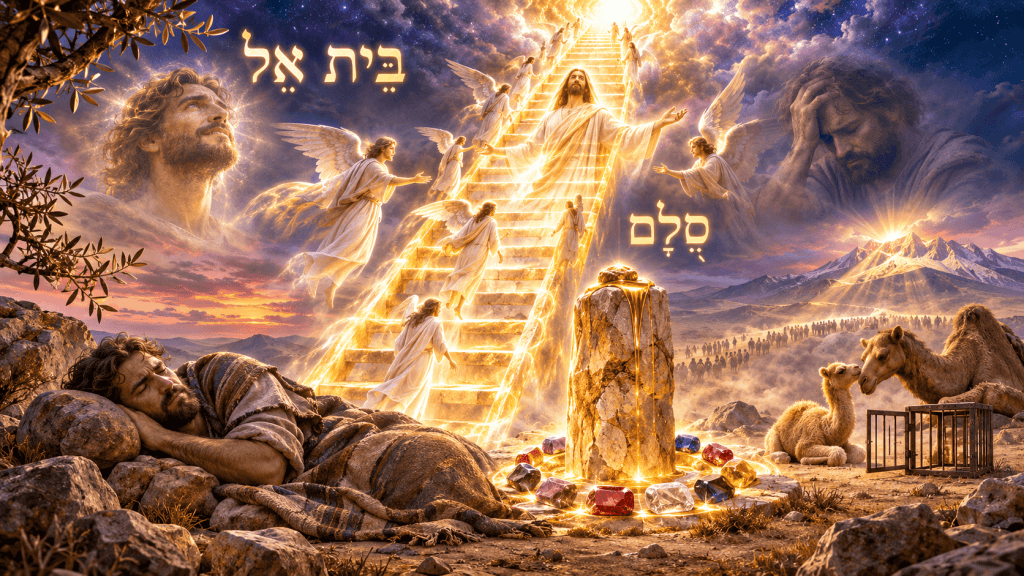
Heaven Touching Earth
Torah portion Vayetze — “And He Went Out”
The Dream at Bethel
Jacob was running. Fleeing from his brother Esau’s wrath, leaving behind his mother’s tent and his father’s blessing, he headed toward Haran to find a wife from his uncle Laban’s household. The sun was setting. He was alone, exhausted, and no doubt wondering if the promises made to his grandfather Abraham and his father Isaac could possibly apply to a fugitive like himself.
He stopped for the night at “the place” — a seemingly random spot on the road — gathered stones for his head, and fell asleep. And there, in a dream, the heavens opened.
He saw a ladder. Not a small ladder, but one that reached from earth to heaven, with angels of God ascending and descending upon it. And at the top stood the LORD Himself, who spoke words of covenant and promise: “I am with you and will keep you wherever you go… for I will not leave you until I have done what I have spoken to you” (Genesis 28:15).
When Jacob awoke, he declared: “Surely the LORD is in this place, and I did not know it!” He took the stones he had slept on, set them up as a pillar, anointed it, and named the place Bethel — the House of God.
This story is far more than a children’s Sunday school lesson. It is a profound revelation of the connection between heaven and earth — and of our own calling to be that connection.
The Ladder: A Person, Not a Thing
Many have asked throughout the ages: What is the ladder? What does it represent?
The Hebrew word for ladder is sulam (סולם). Intriguingly, the numeric value of sulam in gematria is 130 — exactly the same as Sinai (סיני). This is no coincidence. At Mount Sinai, heaven and earth touched. The Torah was given. God descended in fire, and Moses ascended into His presence.
But the sages and the apostles reveal something even deeper. Yeshua Himself told Nathaniel: “You will see heaven opened, and the angels of God ascending and descending on the Son of Man” (John 1:51). Yeshua is the Ladder. He is the conduit between the infinite and the finite, the bridge between the Creator and His creation.
As the Living Torah made flesh (John 1:14), He is our High Priest who presents our offerings before the Father. He is “the Way, the Truth, and the Life” — the only way to the Father (John 14:6). The Ladder is not merely a vision Jacob saw; it is a Person through whom all prayers ascend and all blessings descend.
Two Faces, One Image
But there is more. The angels ascending and descending on the ladder were not just traveling between realms — they were examining Jacob’s life from two perspectives.
The sages teach that each of us has two images: one from above (how God sees us, our potential in His mind) and one from below (how we see ourselves, limited by our circumstances, flaws, and past failures). The purpose of the angels’ ministry within us is to bring these two faces into alignment — that the outward expression of our behavior would match the inner person God created us to be.
This is the secret of panim — the Hebrew word for “face.” Throughout the Jacob narrative, faces appear and reappear: Jacob seeking to appease the face of Esau, Jacob wrestling with God face to face at Peniel, Jacob speaking to Esau as one who had “the face of an angel” (Genesis 33:10).
Jacob teaches us what it means to be a man of truth (Micah 7:20). Though he began with deception, every subsequent decision rectified that initial misstep. He worked for twenty-two years to become the man God envisioned — not merely the “in progress model” he was at the moment, but the tiferet (balance) between Abraham’s mercy and Isaac’s strength.
When we see ourselves as God sees us — as soulful diamonds, ambassadors of the Most High, rays of heavenly light filled with goodness and potential — we give ourselves and others the tools to unify the earthly and heavenly images. And when we keep God’s view of us before our eyes, we gain the power to overcome temptation, just as Joseph overcame Potiphar’s wife by holding fast to his father’s ladder vision.
The Stones That Became One
Consider the stones in this story. Jacob gathered multiple stones for his head (mera’ashot), yet when he awoke, he took “the stone” and set it as a pillar. The many became one.
This is a picture of the body of Messiah — many members, yet one body (1 Corinthians 12:12). It is a picture of the twelve tribes, each a distinct stone in the High Priest’s breastplate, each a living stone in the spiritual house being built by God (1 Peter 2:5).
The Bible’s first mention of stones is in the story of Babel, where men made bricks — uniform, man-made, mass-produced. But God calls us stones — individuals, unique, precious, each needed for the structure of His dwelling place. The chief cornerstone is Yeshua Himself, the Stone the builders rejected (Psalm 118:22).
And there is a beautiful Hebrew play on words: the stone is called even (אבן), which is a contraction of av (אב, father) and ben (בן, son). The Stone connects the Father and the Son — and it is this Stone that will fill the earth and become a great mountain (Daniel 2:35).
Jacob’s journey from Bethel to Laban’s house to his eventual return is the journey of every soul: an adventure filled with honest accounting, opportunities for righteousness, unexpected challenges, and divine encounters. Twenty-two years later, he would build another stone altar — this time with his entire family — a covenant marker between Laban’s worldly mindset and Israel’s spiritual one.
The Dust of the Earth
When God blessed Jacob at Bethel, He declared: “Your descendants shall be as the dust (afar) of the earth” (Genesis 28:14). This is a curious blessing. Why “dust” rather than “stars” or “sand”?
The word afar can mean dust, dirt, ashes — even rubbish. The serpent was cursed to eat dust (Genesis 3:14). Humankind was formed from dust (Genesis 2:7). So why would God compare Jacob’s descendants to this substance?
Perhaps because dust has a remarkable quality: it always rises to the top. People trample on dust, but in the end, the dust covers those who trample it. The dust remains. It cannot be destroyed.
And perhaps because it reminds us of our humility. We are nothing but dust (Psalm 103:14), yet God is mindful of us. He forms us from dust and breathes into us the breath of life. When we embrace our lowliness, we make room for His glory to fill us.
Why Are We in a Cage?
A story that ends with a profound parable. A baby camel asks his mother why they have flat feet, long eyelashes, and water-storing humps. The mother explains each feature as God’s design for traversing desert wastelands. The baby camel then asks: “If this is the case, why are we in a cage in this zoo?”
The question burns for us as well: Why do we live below our calling? Why do we feel undeserving and unable? Why do we remain confined by negative self-talk, family patterns, and cultural conditioning when God designed us to traverse the barren places of this world and bring heaven down to earth?
We do not belong in a cage. We are living stones, called to be the ladder that connects heaven and earth. We are called to reveal the divine spark within each of us — to let our light shine so that others may see our good works and glorify our Father in heaven (Matthew 5:16).
The Aaronic Blessing
The Aaronic blessing reminds us that God wants His face to shine upon us. He does not hang His head in shame. He lifts His face upon us and gives us peace (Numbers 6:23–27).
This is the answer for overcoming the world: focus on getting your two faces — the inward and the outward — as one. Unify the earthly and heavenly images. Then let your light shine.
Jacob’s ladder is more than a one-time dream. It is a Person. It is the Way. It is a calling. We are the ladder. May the ladders of our lives connect heaven and earth for those around us to see — one stone at a time, one face at a time, until the whole house of God is complete and all nations stream to the mountain of the LORD (Isaiah 2:1–4).
May the Lord bless you and keep you; may He make His face shine upon you and be gracious to you; may He lift up His countenance upon you and give you peace.
Shalom!


Leave a Reply