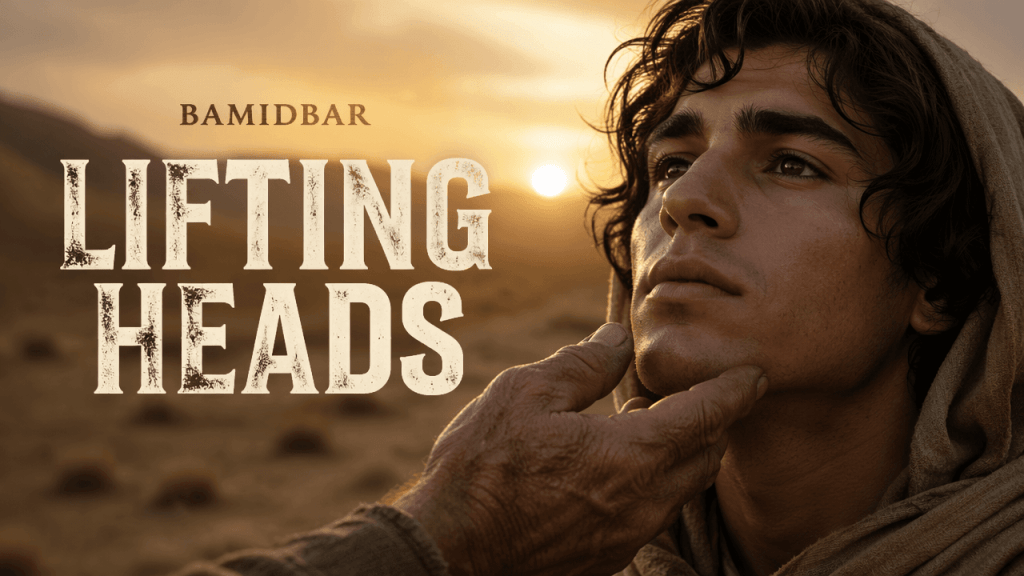
Lifting Heads, Giving Responsibility, and Preparing for War
Torah Portion: Bamidbar (Numbers 1:1 – 4:20)
“Take a census of all the congregation of the children of Israel, by their families, by their fathers’ houses, according to the number of names, every male individually, from twenty years old and above — all who are able to go to war in Israel.” (Numbers 1:2-3)
We have finished Leviticus. We have walked through the laws of sacrifice, the ordination of the priesthood, the distinguishing between clean and unclean, the holiness code, the Sabbaths, the Shmita, and the Jubilee. We have climbed the mountain and received the statutes. Now, as we open the book of Bamidbar — the book of Numbers — we find ourselves in a very different place.
Literally, we find ourselves in the wilderness.
Bamidbar means “in the wilderness.” The Hebrew word midbar comes from the root davar — word. The wilderness is the place of the Word. It is the place where distractions fall away, where the noise of the city fades, where the comforts of Egypt are left behind, and where the Holy One speaks to His people most clearly.
But the wilderness is also the place of preparation. It is the place where slaves become soldiers. It is the place where a mob becomes an army. And it is the place where the Holy One does something remarkable: He lifts their heads, He gives them responsibility, and He prepares them for war.
From Slaves to Soldiers: The Census of the Second Year
The book of Numbers opens on the first day of the second month of the second year after the Exodus. The tabernacle is built. The priesthood is consecrated. The tribes are organized. The leaders are appointed. One year — thirteen months, to be precise — has passed since the blood of the Passover lamb was applied to the doorposts of their homes in Egypt.
In that short time, a nation of former slaves has been transformed into a structured, functioning, covenant community. They have received the Torah. They have built a sanctuary. They have learned to keep the Sabbath. They have tasted manna from heaven and water from the rock.
And now, the Holy One gives a command: “Take a census.”
But this is not a census like the world takes. The world counts people as statistics — numbers on a spreadsheet, data points for taxation or military conscription. The world’s censuses are about power, control, and resources.
The Holy One’s census is different. The Hebrew phrase is not “count the people.” It is nasa rosh — literally, “lift up the head.”
When your head is down, you are discouraged, defeated, downcast. You cannot see the horizon. You cannot see the future. You cannot see the enemy approaching or the Promised Land waiting. But when someone lifts your head, they are saying: “You matter. You have value. You are seen. You are not just a number — you are a person with a name, a family, a purpose.”
This is the first act of the book of Numbers. The Holy One commands Moses to lift the heads of the people. To remind them that they are not anonymous slaves. They are the children of Israel. They are His treasured possession. They count.
Paqad: The Gift of Responsibility
But lifting the head is only the first step. The second step is found in the word paqad — which appears repeatedly in the opening chapters of Numbers. Paqad is often translated “to number” or “to muster,” but it carries a deeper meaning. It means to appoint, to assign responsibility, to entrust with a duty.
When the Holy One counts someone, He does not merely acknowledge their existence. He gives them something to do. He assigns them a role. He entrusts them with a function in the body.
This is the genius of God’s design. Every person from twenty years old and upward — every male eligible for military service — is not just counted. He is paqad. He has a specific place in the camp. He has a specific tribe. He has a specific flag. He has a specific position around the tabernacle. He has a specific role when the camp moves and when the camp stops.
No one is useless. No one is anonymous. No one is a bystander.
The teacher in this week’s portion draws a powerful parallel to the human body. Every organ, every limb, every cell has a function. The heart does not need to be reminded to beat. The eyes do not need to be told to blink. The salivary glands do not need to be coaxed to produce saliva. They simply do what they were designed to do. And when every part functions properly, the body is healthy and strong.
This is what the body of the Messiah is meant to be. Not a crowd of spectators watching a performance, but a mobilized army where every member knows their role, takes responsibility, and works in harmony with the others.
The Age of War: Twenty Years and Upward
The census in Numbers 1 is not for everyone. It is specifically for “every male from twenty years old and upward, all who are able to go to war in Israel.”
Why twenty? In Jewish tradition, the age of responsibility begins at thirteen for boys (bar mitzvah) and twelve for girls (bat mitzvah). At that age, a young person becomes a ben mitzvah — a son or daughter of the commandment — and takes on the personal responsibility to study and keep the Torah.
But the age of war is twenty. From thirteen to twenty is seven years — a complete cycle of training, apprenticeship, and maturation. A young man spends seven years learning the Torah, growing in character, and preparing for the responsibility of defending the nation.
Not every twenty-year-old is required to go to war, however. Later in the Torah (Deuteronomy 20 and 24), we learn of exceptions:
- One who has built a new house but has not yet dedicated it
- One who has planted a vineyard but has not yet harvested its fruit
- One who is betrothed but has not yet married
- One who is afraid or fainthearted
The Holy One prioritizes life, joy, and relationship over warfare. He would rather a man celebrate his new home, enjoy the fruit of his vineyard, and consummate his marriage than go into battle. And He would rather a fearful soldier stay home than spread his fear to the ranks.
This is the opposite of the world’s way. The world consumes its young for the sake of power and empire. The Holy One guards them, honors them, and gives them space to live.
But for those who are ready — those who have matured, who have been trained, who are not distracted by unfinished business, and who are not paralyzed by fear — there is a war to fight.
The Word for War: Tzavah and Milchamah
The Hebrew language gives us two important words related to warfare in this portion.
The first is tzavah, which means “to join together” or “to muster.” An army is a tzava — a group of people who have been gathered, organized, and united under a single command. They move in rhythm, in cadence, in unity. The word evokes images of soldiers marching in formation, left-right-left, each one in sync with the others.
When the Holy One counts the people by their armies (tzivot), He is creating order out of the chaos of the wilderness. He is turning a rabble of former slaves into a disciplined force.
The second word is milchamah, which means “war.” Its root is lechem — bread. At the center of every spiritual battle is the Word of God, the bread that comes down from heaven. The warfare of the believer is always about the Word. Will we trust it? Will we obey it? Will we fight for it? Will we defend it against the lies of the enemy?
The battle is not against flesh and blood. It is against the spiritual forces that seek to steal the bread of life from our mouths. And the army that is prepared for this war is not an army of professional soldiers — it is an army of ordinary people who have had their heads lifted and been given responsibility.
The Wilderness: The Place of the Word
The book is called Bamidbar — “in the wilderness.” The wilderness is not a punishment. It is a classroom. It is the place where the Holy One speaks, because there are no distractions.
In the city, there is noise. There are stores, restaurants, jobs, traffic, entertainment, and endless busyness. In the wilderness, there is silence. There is only the sand, the sky, the pillar of cloud by day, the pillar of fire by night, and the voice of the Holy One.
Many of us avoid the wilderness. We fill our lives with activity, with noise, with the constant buzz of screens and schedules. We are afraid of silence because in silence we might hear what He has to say — and what He has to say might require us to change.
But the wilderness is where we grow. It is where we mature from thirteen to twenty. It is where we move from being sons of the commandment to being soldiers in the army. It is where we learn that we are not just counted — we are responsible.
The Twelve Tribes: The Facets of the Soul
The teacher promises a deeper study of the twelve tribes and their arrangement around the tabernacle, connecting them to the twelve facets of the soul. This teaching — drawn from Jewish mystical tradition — reveals that the camp of Israel is a mirror of the human person.
- Three tribes to the east: Judah, Issachar, Zebulun
- Three tribes to the south: Reuben, Simeon, Gad
- Three tribes to the west: Ephraim, Manasseh, Benjamin
- Three tribes to the north: Dan, Asher, Naphtali
And in the center, the tabernacle — the dwelling place of the Holy One.
This is the structure of the soul. When all twelve facets are in proper relationship — when each part is functioning as designed, when each responsibility is being carried out, when each “tribe” is doing its job — then the soul is healthy, strong, and at peace. The Shekinah dwells in the center.
But when one tribe is out of alignment — when one facet of the soul is neglected or distorted — the whole camp suffers. The tabernacle is still present, but the glory is diminished. The army is weakened.
The counting of the Omer is the process of re-aligning the tribes. Each week focuses on a different midot (character traits). Each day is an opportunity to examine one facet of the soul and bring it back into alignment with the Word. By the time we reach Shavuot — the 50th day — we are meant to be a fully integrated, fully functional, fully mobilized army, ready to receive the covenant and fight the war.
Practical Application: Living the Census Today
What does this mean for us, on the 37th day of counting the Omer, as we open the book of Bamidbar?
First, allow your head to be lifted. You are not a statistic. You are not a number. You are seen. You are valued. You have a name. You have a family. You belong to the camp of Israel. Let the Holy One lift your chin, look into your eyes, and say: “You count. You matter. You are Mine.”
Second, embrace your responsibility. You have been paqad. You have been given a role. You have something to do in the body of Messiah. If you do not know what it is, ask. Seek. Search. The Holy One does not assign roles randomly. He has prepared good works in advance for you to walk in (Ephesians 2:10). Find yours. Own it. Do it.
Third, prepare for war. The war is not against people. It is against the spiritual forces that oppose the Word of God. Every day, there is a battle for your heart, your mind, your time, your resources, your family, your community. You cannot fight this war as a civilian. You must be trained. You must be disciplined. You must be part of an army.
Fourth, embrace the wilderness. Do not run from the dry, barren, quiet places. They are not empty — they are filled with the davar, the Word. Turn off the noise. Step away from the distractions. Let the wilderness speak to you. Let the Word reshape you.
Fifth, grow from thirteen to twenty. If you are a child in the faith, rejoice in your bar mitzvah moment. Take responsibility for your own spiritual growth. But do not stay there. Press on. Let the seven years of training do their work. Become a soldier. Become someone who can be counted on in the day of battle.
Conclusion: The Army Is Being Formed
The book of Bamidbar opens with a census. But it is not a dry administrative exercise. It is the formation of an army. It is the assigning of roles. It is the preparation for the journey ahead.
As we continue counting the Omer, we are not merely marking days. We are being mustered. Our heads are being lifted. Our responsibilities are being assigned. We are being prepared for war — not a war of violence, but a war of the Word. A war for the souls of men. A war against the chaos of the wilderness.
The camp is being formed. The tribes are taking their places. The tabernacle is at the center. And the Holy One is counting His soldiers.
Are you counted?
Shalom.
“Who are these who fly like a cloud, and like doves to their windows?” (Isaiah 60:8)
May your head be lifted, your responsibility be clear, and your heart be ready for the war.


Leave a Reply