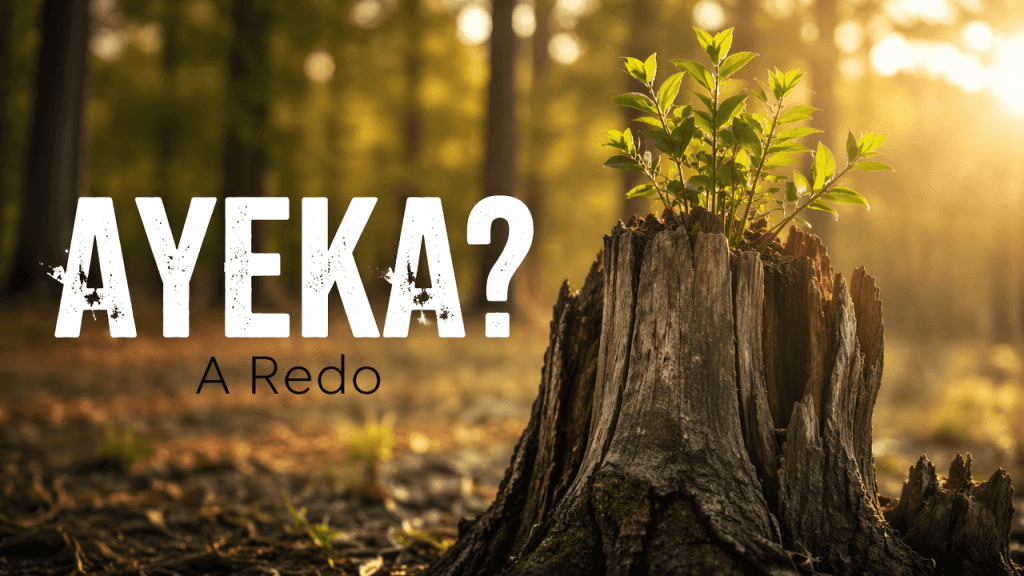
A Redo of the Garden of Eden
Torah Portion: Bechukotai (Leviticus 26:1 – 27:34)
“I will walk among you and be your God, and you shall be My people.” (Leviticus 26:12)
In the cool of the day — the appointed time of breathing — the Lord God walked in the garden. This was not a casual stroll. It was an appointment. A divine date between the Creator and His beloved creation. The Hebrew phrase literally means “the time of the breath” or “the wind of the day” — a moment when the Ruach (Spirit) moved freely between God and man, inhale and exhale, a sacred rhythm of intimacy.
But on this particular day, something was wrong. Adam and his wife were not there. They were hiding among the trees, covering themselves with fig leaves, ashamed and afraid.
And the Lord God called out: “Ayekah? Where are you?”
He is omniscient. He knew exactly where they were. The question was not for His benefit. It was for theirs. “Ayekah” — unlike the casual “eifo” (where are my car keys?) — is a word of relationship. It means: “You are supposed to be here with Me. This is our appointed time. Why are you not walking with Me?”
This is the tragedy of Genesis 3. And this is the promise of Leviticus 26.
The Garden Lost: What Happened to the Walk?
The story of the fall is familiar. The serpent deceived. The woman ate. The man ate. Their eyes were opened. They saw their nakedness. They were ashamed. They hid.
But beneath the surface of this familiar narrative lies a deeper tragedy. The Holy One was not angry in the way we often imagine. When we read the Hebrew, we discover that His question — “Who told you that you were naked?” — is not the roar of an offended Judge. It is the sigh of a grieving Father. He is not enraged. He is sorrowful.
The intimacy of the garden was broken. The mutual walk — the hitpa’el form of walking together, two beings moving in harmony — was shattered. Adam and his wife were no longer walking with God. They were hiding from God.
And the Holy One, in His great love, did not destroy them. He covered them. He clothed them with garments of skin — the first hint of the blood that would one day cover the nakedness of all humanity. And He began the long, slow process of restoration.
The Garden Restored: A Promise of Walking Again
Fast forward to Leviticus 26. The children of Israel are at Mount Sinai. They have been delivered from Egypt. They have received the Torah. They are about to enter the Promised Land. And the Holy One gives them a conditional promise:
“If you walk in My statutes and keep My commandments, and do them… I will walk among you and be your God, and you shall be My people.” (Leviticus 26:3, 12)
The Hebrew word for “I will walk” is v’hithalachti. It is the hitpa’el form of the verb “to walk.” This is significant because the hitpa’el can mean either reflexive (I walk by myself) or mutual (we walk together). In this context, it is clearly mutual. The Holy One is promising: “If you will walk in My ways, then I will walk with you. We will walk together. The garden will be restored.”
This is the redo. This is the second chance. What was lost in Eden is being offered again at Sinai.
Notice the progression:
- First, the Holy One says, “If you walk in My statutes” — this is our part. We walk in His ways, even the chukkim (statutes) that do not make immediate sense to us. We trust Him enough to obey, even when we do not understand.
- Then, He responds: “I will walk among you” — this is His part. He does not stand at a distance. He does not turn His back. He walks in our midst, in our daily lives, in our ordinary moments.
- Finally, He declares the goal: “I will be your God, and you shall be My people” — this is the covenant relationship. This is the garden restored. This is shalom.
This is what we are counting toward. The 50 days from Passover to Shavuot are not merely about waiting for a historical anniversary. They are about walking — step by step, day by day — back into the garden. Back into the cool of the day. Back into the appointed time of breathing with our Creator.
The Aleph and Tav: Walking with the One Who Is First and Last
In the Hebrew text of Leviticus 26, there is a beautiful hidden marker. The section that begins with the promise of blessing (verse 3) opens with the letter Aleph — the first letter of the Hebrew alphabet. The section ends with verse 13, and its final letter is Tav — the last letter of the Hebrew alphabet.
Aleph and Tav. The first and the last. The beginning and the end. In Hebrew, these two letters appear together throughout the Tanakh as the untranslated et (את), pointing to the One who declared in the Brit Chadashah: “I am the Alpha and the Omega, the First and the Last” (Revelation 1:8).
When we walk in His statutes, we are walking with the Aleph and the Tav — with Yeshua Himself, who is the same yesterday, today, and forever. The path of obedience is not a burden. It is the pathway back to the garden. It is the pathway back to walking with God in the cool of the day.
But there is another detail. The section that begins with the curses (verse 14) opens with the letter Vav and ends with the letter Hey. Vav and Hey form the second half of the sacred Name — Yod-Hey-Vav-Hey. Vav-Hey represents, in some traditions, the “back” of God rather than His face.
When we walk contrary to Him — when we hide among the trees, when we refuse to walk in His statutes — we do not see His face. We see His back. We experience His absence rather than His presence. We hear the question “Ayekah?” — “Where are you? Why are you not walking with Me?” — but we do not feel His breath.
But when we walk in His ways, when we keep His Sabbaths and reverence His sanctuary, when we trust His chukkim even when we do not understand them — then He walks with us. Face to face. Breath to breath. Garden to garden.
Breaking the Yoke: Walking Upright
Leviticus 26:13 concludes the blessing section with a powerful promise: “I am the Lord your God, who brought you out of the land of Egypt, that you should not be their bondmen; I have broken the bands of your yoke, and made you walk upright.”
This is the result of walking with God. He breaks the yoke. He doesn’t just loosen it or adjust it — He shatters it. The yoke of Egypt. The yoke of sin. The yoke of fear. The yoke of shame. The yoke of hiding.
And then He makes us walk upright. The Hebrew word implies standing tall, walking with dignity, walking in freedom, walking in the confidence of a child who knows their Father is holding their hand.
This is what the counting of the Omer is leading toward. On the 33rd day — today — we are more than halfway to Shavuot. The wilderness journey is long, but the destination is in sight. And the destination is not merely a mountain or a feast or a historical memory. The destination is a restored walk — a redo of the garden — where the Holy One walks among us, and we walk with Him, and the yoke is broken, and we stand upright.
Practical Application: How to Walk Back to the Garden
How do we apply this? How do we move from hiding among the trees to walking with God in the cool of the day?
1. Stop hiding. The first step is to stop hiding. We hide behind our busyness, our excuses, our theological arguments, our traditions, our shame. We hide in the forest of “I know better” and “that doesn’t make sense” and “nobody else does that.” But the Holy One is still calling: “Ayekah? Where are you? You are supposed to be walking with Me.”
2. Walk in His statutes — even the ones you don’t understand. The chukkim are the commands that seem irrational to the natural mind. The dietary laws. The Sabbath. The appointed times. The details of the sanctuary. We do not keep them because we fully understand them. We keep them because we trust the One who gave them. And in the keeping, the understanding often comes.
3. Look for opportunities, not excuses. The human heart is creative at finding reasons not to obey. “What about this situation?” “What about that exception?” Instead, ask: “How can I do what He has asked?” The shift from excuse-seeking to opportunity-seeking is the shift from hiding to walking.
4. Expect Him to walk with you. This is not a formula. It is a relationship. When you walk in His ways, He promises to walk with you. Not because you have earned it, but because He is faithful to His covenant. Expect His presence. Expect His guidance. Expect His breath.
5. Let Him break your yoke. You cannot break your own yoke. You cannot save yourself from Egypt. But you can stop holding onto the pieces. Let Him do what only He can do. And when He breaks the yoke, walk upright — not in pride, but in the freedom of a child who has been set free.
Conclusion: From Ayekah to Hineini
In the garden, Adam hid and said, “I was afraid because I was naked, and I hid myself” (Genesis 3:10). The Holy One called, “Ayekah?” — “Where are you?”
In Leviticus 26, the Holy One promises that if we walk in His statutes, He will walk among us. The question will no longer be “Where are you?” — because we will be where we are supposed to be: walking with Him.
And when He calls, we will not hide. We will answer like Abraham on Mount Moriah, like Moses at the burning bush, like Samuel in the temple: “Hineini — here I am.”
This is the redo of the Garden of Eden. This is the restoration of all things. This is what we are counting toward.
On the 33rd day of the Omer — with 17 days remaining until Shavuot — let us stop hiding. Let us walk in His statutes. Let us trust His chukkim. And let us expect the promise: “I will walk among you and be your God, and you shall be My people.”
Shalom.
“Open my eyes, that I may see wondrous things from Your Torah.” (Psalm 119:18)
From our house to your house — may you walk with Him in the cool of the day.


Leave a Reply