The Song of the Sea and the Victory Over Chaos
“Who is like unto You, O Lord, among the gods? Who is like You, glorious in holiness, fearful in praises, doing wonders?” (Exodus 15:11)
The stories of Scripture are not 21st-century stories. They were written for ancient cultures with ancient worldviews — cultures that understood the language of mythology, the symbolism of water, and the cosmic battle between chaos and order. When we read these stories through our modern, Western, scientifically trained eyes, we miss much of their depth.
We read about the crossing of the Reed Sea and think it is merely a historical event — a miraculous escape from Pharaoh’s army. And it is that. But it is so much more.
The crossing of the sea is a declaration of war against the underworld. It is a demonstration that the Holy One, the God of Israel, is Lord over chaos, Lord over death, and Lord over every so-called god that has ever claimed dominion over the abyss.
As we count the Omer — now 32 days from First Fruits to Shavuot — we are walking the same journey that Israel walked. We have applied the blood of the Lamb. We have left Egypt. But we have not yet reached the mountain. And between Egypt and Sinai lies the sea.
The Waters of Chaos: From Genesis to Exodus
In Genesis 1:2, we read: “The earth became formless and void, and darkness was upon the face of the deep. And the Spirit of God moved upon the face of the waters.”
Notice: the earth was already there. The waters were already there. The Holy One did not create out of nothing — He created out of chaos. He took a world that had become tohu v’bohu (formless and empty), shrouded in darkness and covered with water, and He began a restorative process.
Over six days, He separated the waters, called forth dry land, brought forth vegetation, created the lights in the sky, filled the sea and sky with living creatures, and finally formed mankind in His own image. On the seventh day, He rested.
This is the pattern. Chaos → Order → Rest.
The creation story is not merely about origins. It is about restoration. It is about the Holy One taking that which has fallen into ruin and making it new. And this same pattern repeats throughout Scripture — most dramatically in the Exodus.
Egypt, in the biblical narrative, represents chaos. It is a death cult, obsessed with the underworld, with mummies, with the Nile, with gods who claim dominion over the abyss. The Holy One’s plan was not merely to free Israel from physical slavery but to bring them out of the realm of death entirely.
The blood of the Passover lamb marked their homes as belonging to the realm of life. But to complete their deliverance, they had to pass through the sea.
The Mythological Battle: Baal-Zephon and the Lord of Hosts
In Exodus 14:2, the Holy One gives Moses a strange command: “Speak to the children of Israel, that they turn and encamp before Pi-hahiroth, between Migdol and the sea, opposite Baal-zephon; before it you shall encamp by the sea.”
Why this specific location? Because Baal-zephon was the Canaanite god of the sea. In ancient mythology, the god who controlled the sea controlled life itself. The sea was the abyss, the underworld, the realm of chaos. To have victory over the sea was to prove yourself the supreme deity.
Pharaoh, seeing Israel trapped between the sea and his approaching army, believed his gods had won. “They are entangled in the land,” he said. “The wilderness has closed them in” (Exodus 14:3). From his perspective, the God of Israel had made a fatal tactical error.
But the Holy One had something to prove. He was not avoiding Baal-zephon. He was confronting him directly — on his own turf.
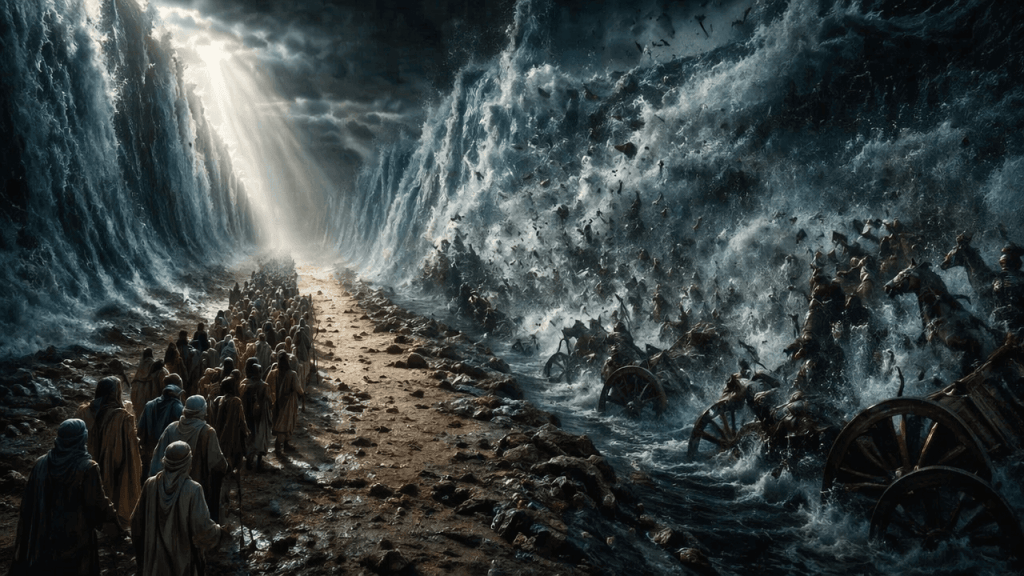
Moses raised his staff. The sea split. The waters stood up like walls. And the children of Israel walked through the sea on dry ground (Exodus 14:22).
The language is deliberate. The Hebrew emphasizes that the water became like dry land. This is not a natural phenomenon. It is a supernatural declaration: the Holy One has authority over the chaos. The sea obeys His command. Baal-zephon is nothing.
When Pharaoh’s army followed Israel into the sea, the waters returned and swallowed them. The enemies of God’s people were destroyed. Their bodies washed up on the shore — a visible sign that the gods of Egypt had been defeated (Exodus 14:30).
The Song of the Sea: A Prophetic Declaration
Exodus 15 records the response of Israel to this victory. It is often called the Song of Moses, but careful reading reveals that it is actually the Song of the Sea — a prophetic declaration that looks forward to an even greater victory yet to come.
Notice the wording in verse 1: “Then sang Moses and the children of Israel this song unto the Lord, and spoke, saying, ‘I will sing unto the Lord, for He has triumphed gloriously.’”
He does not say, “I am singing.” He says, “I will sing” — future tense. This is a prophecy. The complete fulfillment of this song awaits a future day, when the final exodus takes place and the enemies of God are finally and forever defeated.
The Song of the Sea declares:
- “The Lord is my strength and song, and He has become my salvation (Yeshua)” (v. 2).
- “The Lord is a man of war; the Lord is His name” (v. 3).
- “Your right hand, O Lord, has become glorious in power; Your right hand, O Lord, has dashed in pieces the enemy” (v. 6).
- “Who is like unto You, O Lord, among the gods? Who is like You, glorious in holiness, fearful in praises, doing wonders?” (v. 11).
The song ends with a vision of the future: “You will bring them in and plant them in the mountain of Your inheritance, in the place, O Lord, which You have made for You to dwell in — the sanctuary, O Lord, which Your hands have established. The Lord shall reign forever and ever” (v. 17-18).
That mountain is Mount Sinai — the place of covenant, the place of Pentecost, the place where the Holy One would descend in fire and speak His words to His people. But the song looks even further: to the final mountain, the New Jerusalem, where the Lord will reign forever.
Walking on the Water: Yeshua and the Sea
The New Testament continues this theme. When Yeshua walks on the water (Matthew 14:22-33), He is not merely performing a parlor trick to prove His divinity. He is re-enacting the Exodus. He is demonstrating that He, like the Holy One of Israel, has authority over the sea — over chaos, over the underworld, over death itself.
Peter’s request — “Lord, if it is You, command me to come to You on the water” — is a request to participate in the same victory. And Yeshua says, “Come.”
Peter steps out of the boat. He walks on the water. He is doing what Israel did at the Reed Sea: walking through the chaos on dry ground. But then he takes his eyes off the Lord. He looks at the waves — the winds and waves of doctrine, the competing voices, the chaos of the world — and he begins to sink.
“Lord, save me!” he cries. And Yeshua immediately reaches out His hand, catches him, and says, “O you of little faith, why did you doubt?”
The moment they get into the boat, the wind ceases. They are, in a sense, on dry ground — safe on the other side. The story is a perfect picture of Exodus 14: the enemies (the waves) are defeated, and the people are delivered.
The Second Exodus: A Greater Victory to Come
The prophets declare that the Exodus from Egypt was not the final act. There will be a second exodus — a gathering of God’s people from the four corners of the earth — and it will be even more spectacular than the first.
Jeremiah 16:14-15 declares: “Therefore behold, the days are coming, says the Lord, that it shall no more be said, ‘The Lord lives who brought up the children of Israel out of the land of Egypt,’ but, ‘The Lord lives who brought up the children of Israel from the land of the north and from all the lands where He had driven them.’ For I will bring them back into their land which I gave to their fathers.”
In that day, the Holy One will once again part the waters. He will lead His people through rivers, through seas, through the chaos of a world in upheaval. And He will bring them to His holy mountain.
This is what we are preparing for as we count the Omer. The 50 days from Passover to Shavuot are not merely a historical reenactment. They are a spiritual journey. Each day, we leave a little more of Egypt behind. Each day, we walk a little closer to the sea. Each day, we trust that the One who split the waters once can split them again — in our lives, in our circumstances, in the chaos that threatens to overwhelm us.
The Waves of Doctrine: Staying Focused in the Storm
Why do the waves rage? Why does the sea roar? In Scripture, the tossing waves often represent the doctrines of men — the competing teachings, traditions, and ideologies that seek to pull us off course.
Paul warns in Ephesians 4:14: “That we should no longer be children, tossed to and fro and carried about with every wind of doctrine, by the trickery of men, in the cunning craftiness of deceitful plotting.”
James echoes this imagery: “He who doubts is like a wave of the sea driven and tossed by the wind” (James 1:6).
When Peter looked at the waves, he became afraid. He took his eyes off the One who stood above the chaos, and he began to sink. The same thing happens to us. We get distracted by competing voices — by arguments about the rapture, about the tribulation, about the temple, about the law, about grace. We become so consumed with defending our theological positions that we forget to look at the One who is walking toward us on the water.
The remedy is simple, but not easy: keep your eyes on Yeshua. He is the author and finisher of our faith (Hebrews 12:2). He is the one who has victory over the sea. He is the man of war who defeats our enemies. He is the Lord of the underworld, the conqueror of death, the King of kings.
The Days Ahead: Expecting Miracles
As we continue counting the Omer — now 32 days into the journey — we must prepare ourselves for what is coming. The Holy One is not done parting waters. He is not done defeating enemies. He is not done doing wonders.
But here is the challenge: wonders often require sticky situations. The sea did not part until Israel was trapped between Pharaoh’s army and the water. The walls of Jericho did not fall until the Israelites marched around them for seven days. The tomb did not empty until Yeshua had been crucified and buried.
Before the problem arises, the Holy One already has the solution. Before the trial comes, He already has the answer. In the midst of the test, there is a miracle waiting to happen.
Will you be like Peter, focused on the waves? Or will you be like Moses, raising your staff and trusting the One who commands the sea?
Conclusion: Who Is Like You, O Lord?
The Song of the Sea asks a question that no other religion can answer: “Who is like unto You, O Lord, among the gods?”
The gods of Egypt are dead. Baal-zephon is nothing. The underworld has no power. The chaos cannot stand. There is none like the Holy One of Israel — glorious in holiness, fearful in praises, doing wonders.
He is your strength and your song. He has become your salvation — your Yeshua. He is a man of war, fighting on your behalf. His right hand is glorious in power, dashing in pieces the enemy.
And He is leading you — through the sea, through the wilderness, through the counting of the days — to His holy mountain. To Pentecost. To the renewal of the covenant. To the place where He will dwell with you forever.
Do not be afraid of the waters. They obey His voice. Do not be distracted by the waves. Keep your eyes on Him. And soon — on the 50th day — you will stand before Him, not as a slave of Egypt, but as a child of the King.
May you walk through your sea on dry ground today.
Shalom.
“The Lord shall reign forever and ever.” (Exodus 15:18)


Leave a Reply