Training Daily for Your Calling
Torah Portion: Bamidbar (Numbers 1:1 – 4:20)
“From twenty years old and upward, all who are able to go to war in Israel… you and Aaron shall number them by their armies.” (Numbers 1:3)
The 40th day of counting the Omer has arrived. In Scripture, the number 40 is always associated with testing and trial. Forty days of rain in the days of Noah. Forty years of wandering in the wilderness. Forty days of testing for Yeshua in the desert. Forty days from the resurrection to the ascension. Forty is the number of transition — the period of purification, preparation, and proving.
The first 40 days of the Omer journey are about one thing: overcoming the fear of leaving the past behind. It is about walking away from Egypt — not just geographically, but spiritually, emotionally, and psychologically. It is about learning to trust the pillar of cloud and fire when you cannot see the road ahead. It is about dying to the old identity of slavery and being born into the new identity of a free child of the King.
But on the 40th day, something shifts. The testing is not yet complete, but a threshold is crossed. And on this threshold, the Holy One asks a question that every believer must answer: Do you want the title, or do you want the office?
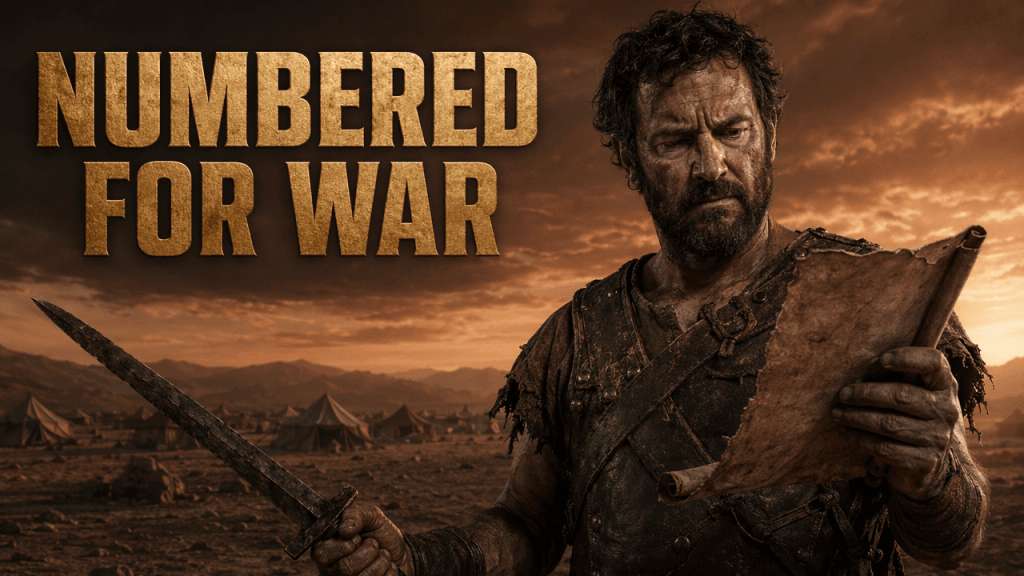
Numbered for War: The Census of the Army
The book of Numbers opens with a census. But this is not a census for taxation or for general population statistics. It is a military census. The Holy One commands Moses to count “every male from twenty years old and upward, all who are able to go to war in Israel.”
Twenty is the age of maturity for warfare. From thirteen (bar mitzvah) to twenty is a seven-year period of training — an apprenticeship in the things of God. During those seven years, a young man learns the Torah, develops character, practices discipline, and prepares his heart for the responsibility of defending the nation.
But here is the critical point: being counted does not automatically make you a warrior. The census identifies those who are eligible to go to war. It does not make them battle-ready. Between the census and the battle lies the training ground.
The children of Israel had been slaves in Egypt. They had no military training. They did not know how to wield a sword, shoot an arrow, or hold a shield. If they had been thrown into battle on the day they left Egypt, they would have been slaughtered. The Holy One did not lead them directly from the Red Sea to the Promised Land. He led them through the wilderness — the midbar, the place of the Word — where they could be trained, tested, and transformed.
The same is true for us. We are saved by grace through faith. The moment we believe, we are justified. The blood of the Lamb is applied to our doorposts. We are delivered from Egypt. But that does not make us battle-ready. Between our justification and our glorification lies the wilderness. And in the wilderness, we are numbered for war — not just as a title, but as a call to training.
The Spies and the Failure of the First Generation
The tragedy of Numbers 13-14 is one of the most sobering passages in Scripture. Twelve spies are sent into the Promised Land. They all see the same thing: giants, fortified cities, and the fruit of the land. Ten bring back an evil report. Two — Joshua and Caleb — bring back a report of faith.
The ten say: “We are not able to go up against the people, for they are stronger than we… we were like grasshoppers in our own sight, and so we were in their sight” (Numbers 13:31-33).
Notice the phrase: “in our own sight.” The giants did not see Israel as grasshoppers. Israel saw themselves as grasshoppers. Their fear was not based on the enemy’s assessment. It was based on their own lack of faith, their own failure to trust the One who had already defeated the gods of Egypt, split the sea, rained bread from heaven, and quenched their thirst from a rock.
The result? The entire generation from twenty years old and upward — the very ones who had been numbered for war — was condemned to die in the wilderness. They would never enter the Promised Land. They had the title of warriors, but they refused the office. They were counted, but they would not fight.
Joshua and Caleb, however, had a different spirit. They said: “Let us go up at once and take possession, for we are well able to overcome it” (Numbers 13:30). They made their calling and election sure. They trained. They trusted. They fought. And they alone of their generation entered the land.
Nathanael Under the Fig Tree: A Warrior’s Calling
In John 1, Yeshua encounters a man named Nathanael. Philip had found him and said, “We have found Him of whom Moses in the law, and also the prophets, wrote — Jesus of Nazareth, the son of Joseph.”
Nathanael’s response is skeptical: “Can anything good come out of Nazareth?” But Philip simply says, “Come and see.”
When Yeshua sees Nathanael approaching, He declares: “Behold, an Israelite indeed, in whom there is no guile!” Nathanael is astonished. “How do You know me?” he asks.
Yeshua answers: “Before Philip called you, when you were under the fig tree, I saw you.”
This is not a casual statement. In the Hebrew Scriptures, to sit under one’s own fig tree is a prophetic picture of peace, security, and messianic rest (Micah 4:4; Zechariah 3:10). It is the image of a faithful Israelite dwelling in the land, ruling and reigning with the Messiah in the age to come.
When Yeshua says, “I saw you under the fig tree,” He is saying: “I saw you in your calling. I saw you in your destiny. I saw you where you are meant to be — not as a slave in Egypt, not as a wanderer in the wilderness, but as a ruler in My kingdom.”
Nathanael immediately confesses: “Rabbi, You are the Son of God! You are the King of Israel!” And Yeshua replies: “Because I said to you, ‘I saw you under the fig tree,’ do you believe? You will see greater things than these… Hereafter, you shall see heaven open, and the angels of God ascending and descending upon the Son of Man” (John 1:50-51).
Yeshua was calling Nathanael to something far greater than a title. He was calling him to an office — to be a witness of the resurrection, a pillar of the early church, and one who would see the heavenly realms opened.
But between the fig tree and the fulfillment lay the training ground. Nathanael would have to leave his nets, follow an itinerant rabbi, endure rejection, witness crucifixion, and risk his life for the gospel. He had the calling. He had to make it sure.
The Vine and the Branches: From Title to Fruit
In John 15, Yeshua gives His disciples the famous teaching on the vine and the branches. He says: “I am the true vine, and My Father is the vinedresser. Every branch in Me that does not bear fruit He takes away; and every branch that bears fruit He prunes, that it may bear more fruit” (John 15:1-2).
The disciples had been given a title. They were called apostles. They were numbered among the twelve. They had walked with Yeshua, heard His teaching, witnessed His miracles. But the title was not enough. They needed to bear fruit — and not just any fruit, but fruit that would remain.
Yeshua goes on: “These things I have spoken to you, that My joy may remain in you, and that your joy may be full” (John 15:11). The joy He speaks of is not merely happiness. It is the joy of the wedding feast — the joy of hearing, “Well done, good and faithful servant. Enter into the joy of your Lord” (Matthew 25:21).
But then Yeshua gives the command: “This is My commandment, that you love one another as I have loved you. Greater love has no one than this, than to lay down one’s life for his friends. You are My friends if you do whatever I command you” (John 15:12-14).
The title — “friend” — is conditional on obedience. Yeshua is not saying that we earn His friendship by works. He is saying that the reality of the relationship is proven by the fruit. The branch that claims to be connected to the vine but bears no fruit is a branch in name only. It has the title. It does not have an office.
Then Yeshua says: “No longer do I call you servants, for a servant does not know what his master is doing; but I have called you friends, for all things that I heard from My Father I have made known to you” (John 15:15).
The progression is clear: servant → friend. But the friend is not a passive recipient. The friend is one who is actively engaged in the Master’s work. The friend bears fruit. The friend lays down his life. The friend does whatever Yeshua commands.
Making Your Calling and Election Sure
The apostle Peter, writing to believers who had been scattered throughout Asia Minor, gives a powerful exhortation. He lists the qualities that must be added to faith:
“Add to your faith virtue, to virtue knowledge, to knowledge self-control, to self-control perseverance, to perseverance godliness, to godliness brotherly kindness, and to brotherly kindness love” (2 Peter 1:5-7).
Then he says: “Therefore, brethren, be even more diligent to make your call and election sure, for if you do these things you will never stumble” (2 Peter 1:10).
Make your calling and election sure. The word “sure” means firm, confirmed, established. It is not enough to be called. We must confirm that calling through a life of active, diligent, intentional growth. It is not enough to be elected. We must walk in that election day by day, step by step, adding virtue to faith, knowledge to virtue, self-control to knowledge, perseverance to self-control, godliness to perseverance, brotherly kindness to godliness, and love to brotherly kindness.
This is the training ground of the wilderness. This is what the 40 days of the Omer are for. And this is what distinguishes those who merely have the title of “warrior” from those who live the office.
Do You Want the Title or the Office?
The teacher in this week’s portion shares a personal story that cuts to the heart of the matter. Early in his ministry, he was discipling many men, leading a large youth group, and pouring his life into the church. When nominations came for Father of the Year, he was not nominated. When nominations came for deacon, he was not nominated. He went to his pastor, confused and hurt, and asked why.
The pastor looked at him and said: “Do you want the title, or do you want the office? You’re already doing the office. Why do you need the title?”
That question changed his life. He walked out of that office realizing that the title is empty without the office. The flag outside the house means nothing if the life inside the house does not match it. The census number is meaningless if the warrior does not train.
This is the trap that many believers fall into. We want to be called “soldiers of the Lord,” but we do not want to get up early for prayer. We want to be called “friends of God,” but we do not want to obey His commands. We want the joy of the wedding feast, but we do not want the pruning that produces fruit. We want the title. We do not want the office.
But the Holy One is not interested in our titles. He is interested in our training. He does not ask if we have been counted. He asks if we are ready to fight. He does not ask if we fly the banner. He asks if we live the banner.
Practical Application: Training for the War
On this 40th day of counting the Omer, consider these questions:
1. Have you been numbered? Are you twenty years old and upward in spiritual maturity? Have you moved beyond the milk of the Word to the solid food? Have you taken responsibility for your own growth, or are you still depending on others to feed you?
2. Are you training daily? What is your daily discipline of prayer, study, and obedience? Are you adding virtue to your faith? Knowledge to virtue? Self-control to knowledge? Perseverance to self-control? Godliness to perseverance? Brotherly kindness to godliness? Love to brotherly kindness?
3. Are you making your calling and election sure? Do you know what the Holy One has called you to do? Are you actively walking in that calling? Are you confirming it through a life of faithful obedience?
4. Do you want the title or the office? Are you content to be called a warrior, or do you actually want to fight? Are you content to be called a friend, or do you actually want to obey? Are you content to be called fruitful, or do you actually want to bear fruit that remains?
Conclusion: The War Is Coming
The 40th day is a threshold. The first 40 days of the Omer are about overcoming the fear of leaving the past behind. The last 10 days are about anticipation and preparation for what is to come at Shavuot.
But between the threshold and the destination lies the training ground. The war is coming. The enemy is real. The battle for the land — for the hearts and souls of men — is not a metaphor. It is the reality for which we are being prepared.
Do not be satisfied with the title. Do not rest on your census number. Do not fly the banner without living the banner.
Train daily. Add to your faith. Make your calling and election sure. And when the day of battle comes — and it will come — you will not stumble. You will stand firm. You will fight. And you will enter into the joy of your Lord.
Shalom.
“Fight the good fight of faith, lay hold on eternal life, to which you were also called and have confessed the good confession in the presence of many witnesses.” (1 Timothy 6:12)
May you be numbered, may you be trained, and may you be found faithful on the day of battle.
 Light In Torah
Leave a comment