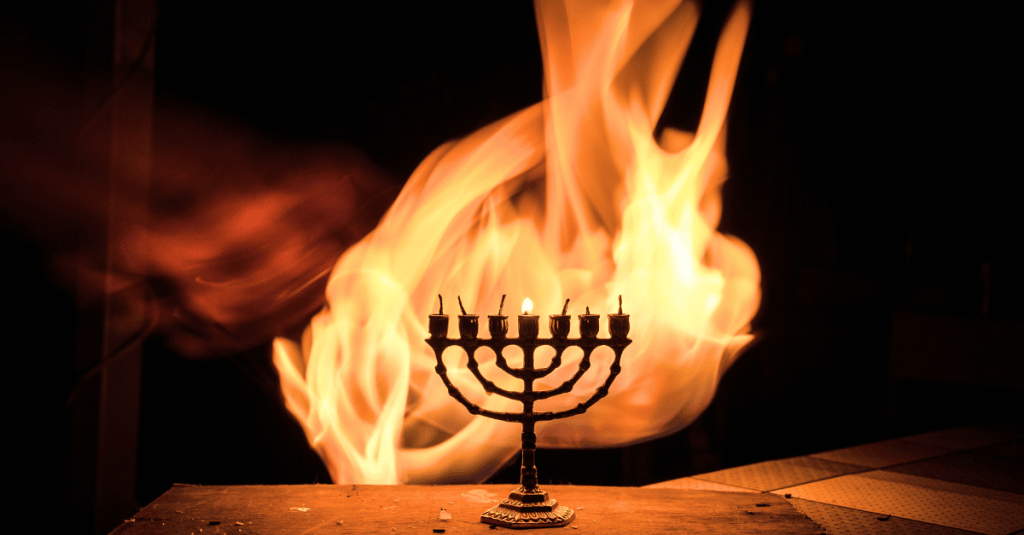
Living His fiery image daily
As we approach the end of March, it’s hard not to feel the swift passage of time. The first three months of 2026 have come and gone in what feels like an instant. This particular Shabbat, known as Shabbat HaGadol—the Great Sabbath—falls right before the Passover celebration. It’s a time of preparation, reflection, and anticipation. Could this be the Passover where everything breaks loose? Where the world’s shifting pieces signal a divine exit stage left? I don’t know. But what I do know is this: I am responsible for my daily responsibilities—whether at work, in my spiritual life, or in my home. Today, I want to focus on what that looks like in light of the eternal fire on the altar.
A Week of Focused Reflection
For the first time in over forty years of studying the Torah portions, I didn’t teach through the entire weekly portion. Instead, I focused on just five verses—Leviticus 6:9–13. Over and over, whether in morning or evening studies, the same theme resonated: the perpetual fire on the altar. This time, I want to build on that theme, specifically looking at the nature of fire itself.
In my own life, I’ve been meditating on four realities of daily living: laying my life down as a living sacrifice, allowing the fire to consume the flesh of my offering, dealing with the ashes of the past, and making room for new mercies each day. This is the rhythm of the korban olah—the burnt offering—which is really about imitating Yeshua by offering myself completely to God.
The Fire: Aish and the Image of God
The Hebrew word for fire is aish (אֵשׁ), spelled with an aleph and a sheen. Aleph represents God, power, and authority. Sheen represents consumption. Together, they form “God consumes.” This is why Hebrews 12:29 declares, “Our God is a consuming fire.”
Fire can do one of two things: it can destroy, or it can purify. In the future, fire will consume all that is not good. But for now, the fire on the altar is about purification. It’s about God sitting as a refiner’s fire, removing the dross so He can see His reflection in us.
This fire is woven into the very fabric of who we are. Man (ish, אִישׁ) is spelled aleph, yud, sheen—fire with a hand. Woman (ishah, אִשָּׁה) is aleph, sheen, hei—fire with the breath of God. When a man stops using his hand to serve and cling to his wife, he becomes a consuming fire. When a woman stops operating through the Spirit, she too becomes a consuming fire. But when both operate in their God-given roles, they become one flesh, and the fire becomes a source of life rather than destruction.
Fire Throughout Scripture
The first fire in Scripture is not at the altar of Noah, nor even in the Garden with the flaming sword. It begins with God Himself. In Exodus 3, Moses encounters the burning bush—fire that consumes but does not destroy. That same fire led Israel as a pillar of fire by night, giving light and warmth in the darkness. In Daniel, Shadrach, Meshach, and Abednego were thrown into a fiery furnace, but because the Son of Man was with them, they were not consumed. Their garments didn’t even smell like smoke.
Yeshua Himself has eyes like flames of fire (Revelation 1). He doesn’t look to destroy, but to purify. He baptizes with the Holy Spirit and fire. At Pentecost, tongues of fire rested on the disciples, empowering them to proclaim the Word. Fire is not just judgment; it is presence, guidance, and power.
The Altar in Our Lives
Leviticus 6:13 commands, “The fire shall ever be burning upon the altar; it shall never go out.” This is the pattern for our lives. We are to be living sacrifices, laid on the altar daily. In the morning, we bring our offering. In the evening, we do it again. And in between, we deal with the ashes.
The ashes represent the residue of yesterday—both the failures and the successes. One of my mentors used to say, “The greatest enemy of excellence is being good.” Success can breed mediocrity if we rest on past achievements. The ashes must be removed from the altar and taken to a clean place, making room for a fresh offering. This is the daily discipline of walking with God.
Quenching the Spirit
In 1 Thessalonians 5, Paul gives a series of rapid-fire instructions: rejoice always, pray without ceasing, in everything give thanks—for this is the will of God in Christ Jesus concerning you. Then he says, “Quench not the Spirit.” The Spirit is the fire. When we stop giving thanks, when we stop praying, when we stop rejoicing, we begin to quench the fire.
The simplest way to keep the fire burning is gratitude. Gratitude fuels the fire of the Spirit, keeps the altar hot, and ensures that the offering is consumed. It’s the daily discipline of choosing to believe what God says over what we feel.
The Divider of Families
Yeshua said in Luke 12:49, “I came to send fire on the earth, and how I wish it were already kindled!” He came to bring division—not peace in the superficial sense, but a sword that separates truth from tradition, Spirit from flesh. That division often begins in the home. A family of five becomes divided three against two. Why? Because the fire of God’s Word, beginning with Moses and the prophets, cuts through cultural compromise.
On the road to Emmaus, Yeshua walked with two disciples whose hearts were burning within them as He opened the Scriptures—starting with Moses. That fire in the heart is what brings clarity and conviction. It separates what is from what should be.
Pay Now or Pay Later
There is a choice before each of us. We can lay our lives on the altar now, allowing the fire to consume the impurities, the successes, the distractions. We can deal with the ashes daily, taking them to a clean place and making room for new mercies. Or we can wait until the final fire—the one that will consume everything not aligned with God’s kingdom.
2 Peter 3 reminds us that the heavens and earth are being reserved for fire. But that same fire, when applied now, is purifying. It burns away the dross. It prepares us for the day when the new heavens and new earth will appear, where righteousness dwells.
Conclusion: Becoming Yah
In our relationships—especially marriage—the goal is to become one flesh. When the man brings his yud (hand) and the woman brings her hei (Spirit), together they form Yah—the name of God. Two becoming one, united in fire and purpose.
So this Shabbat HaGadol, let us tend the fire on the altar of our lives. Let us offer ourselves daily, remove the ashes, and make room for the new. Let us not quench the Spirit, but instead give thanks in everything. And let us trust that the same fire that consumed the burnt offering also purifies, guides, and draws us closer to the One whose eyes are like flames of fire.
Shabbat Shalom.
Alan
Speaking of flames and fire, you’ll want to be a part of finishing our daily altar studies by listening to a fairly comprehensive study on ‘keep the fire burning on the altar’. Enjoy, letting the Word set your heart on fire (Jer. 20:9).
 Light In Torah
Leave a comment