Lessons from the Life of Sarah and Rebecca
By Alan Lee
As we navigate the weekly Torah portions, we often encounter passages that challenge our understanding and compel us to dig deeper. This week, we find ourselves in Genesis 23, studying Chayei Sarah—”the life of Sarah.” It is a striking title for a portion that begins with her death. This paradox is the first of many lessons the Lord has for us in these chapters, lessons that ultimately point us toward the ultimate goal: being prepared as the Bride of the Messiah.
The Life We Are Called to Live
The text tells us Sarah lived to be 127 years old. But in Hebrew, it is written in a unique way: “a hundred and seven and twenty years.” The rabbis note that this division into three parts—100, 20, and 7—is intentional. It teaches us about the character of this great matriarch.
At 100, she possessed the wisdom of a sage. At 20, she had the responsibility, energy, and devotion of a young adult ready to take on the world. And at 7, she retained the innocence, wonder, joy, and “silliness” of a child. She never lost her childlike faith, never let the burdens of adulthood steal her joy.
This is our goal: to live with the wisdom of a sage, the responsibility of an adult, and the innocent, trusting wonder of a child. It is a holistic life, fully devoted to God.
Yet, Sarah’s death is shrouded in sadness and loneliness. Her husband Abraham was away, her son Isaac was in the south country, and her stepson Ishmael was absent. She died alone. It’s a sobering reminder that even the patriarchs and matriarchs faced the complexities and pains of a fallen world. And it’s a moment that could easily lead us to ask the most human of questions: “Whose fault is it?” The blame game.
But as Yeshua taught us when his disciples asked who sinned to cause a man to be born blind, the answer is not about blame. It is about perspective. The day we stop blaming and take responsibility is the day we are truly free. We must learn to say, “I was wrong. Please forgive me.” We must accept, change, and move forward in the grace of God.
A Picture of the Bride
While Sarah’s death leaves us with questions, the story of her son Isaac and his bride Rebecca gives us a glorious and detailed picture of the relationship between Messiah Yeshua and His Bride. It is a picture many of us know, but one we must review until it moves from our heads to our hearts. Because knowing about the Bride is not the same as being the Bride.
After the events of the Akedah (the binding of Isaac) in Genesis 22—a clear picture of the Father offering His Son—Isaac is not seen again until the very end of chapter 24, after a bride has been procured for him. He is a picture of the resurrected Messiah, ascended to the right hand of the Father, waiting for His Bride to be made ready.
Abraham, the father, calls his eldest and most trusted servant, Eliezer, to undertake a critical mission. He makes him swear a solemn oath: “You shall not take a wife for my son from the daughters of the Canaanites… but you shall go to my country and to my relatives, and take a wife for my son Isaac.”
This is a perfect picture of our own salvation story. The Father sends the Holy Spirit—His Servant—into the world. The Spirit’s mission is not to go to the “Canaanites,” a people representing worldliness, materialism, and a spirit that never rests. Instead, He is sent to the Father’s family, to find a Bride for the Son.
The Mark of the Bride: Willingness and Service
Eliezer’s journey is a powerful picture of the Spirit’s work today. He prays for success, not for his own glory, but for the glory of his master, Abraham. He asks for a specific sign:
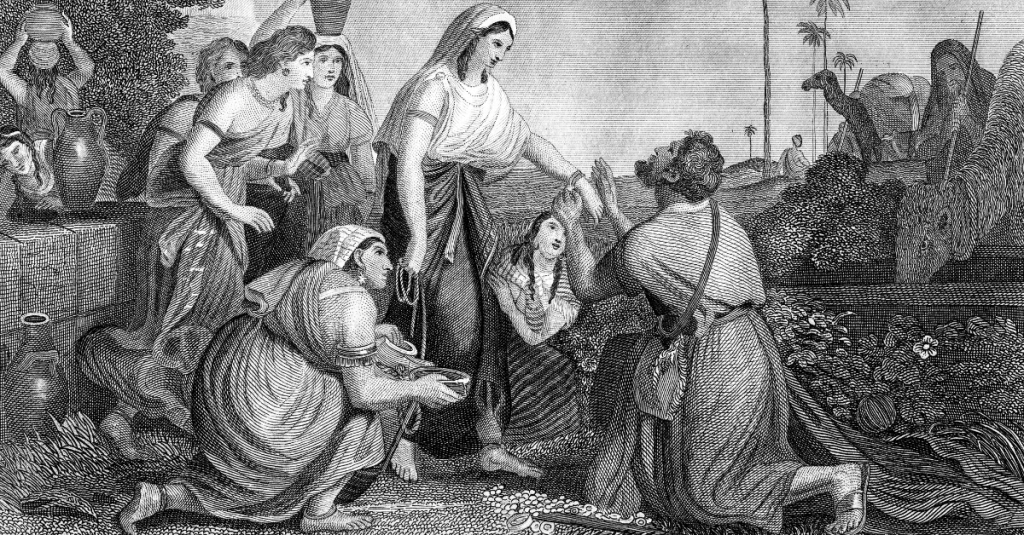
“Behold, I am standing by the spring of water, and the daughters of the men of the city are coming out to draw water. Now may it be that the young woman to whom I say, ‘Please let down your jar so that I may drink,’ and who answers, ‘Drink, and I will water your camels also’—may she be the one whom You have appointed for Your servant Isaac.”
Why this specific test? Because he wasn’t looking for just a pretty face (though Rebecca was beautiful). He wasn’t looking for someone who was merely polite. He was looking for a servant. He was looking for someone with the same heart as Abraham—a heart ready to run to meet a need.
Before he had even finished praying, Rebecca appeared. And she did exactly what he asked. When he asked for a drink, she didn’t just give him one. She ran back to the well and drew water for all ten of his camels. Scholars estimate that a thirsty camel can drink up to 50 gallons. That means Rebecca likely drew hundreds of gallons of water, making dozens of trips up and down from the well. That is not just hospitality; that is sacrificial, relentless service. That is bride material.
This is the heart of the Bride of Messiah. It is not enough to simply be part of the “family” (the body of believers). Everyone in Abraham’s house will receive gifts. But only one became the bride. The Bride is marked by a willingness to go above and beyond, to run to do the work of the Master, to serve without counting the cost.
The Way and The Willingness
When Eliezer recounts the story, he makes a profound statement: “I, being in the way, the Lord led me.” He was walking in the path of obedience, and there he found the bride.
The early believers were not called “Christians” by themselves; they were known as followers of “the Way.” The Bride of Messiah is found walking in the Way—the way of wisdom, righteousness, and truth. She is actively living out her faith.
When asked if she would go with this man to a land she had never seen, to marry a man she had never met, Rebecca’s answer was immediate and decisive: “I will go.”
This is the ultimate test of faith. The Spirit of God is moving through the family of God today, calling out a Bride. There will be voices that try to delay us: “Stay a little longer. Enjoy the world a little more. Don’t be so hasty.” But the Bride’s heart cries out, “I will go.” She is willing to leave her old life behind to be with the Son.
The Comfort of the Son
The chapter ends with a beautiful scene. Isaac has been waiting. He goes out into the field to meditate, to pray. He looks up and sees the camels coming. Rebecca sees him, and with reverence and humility, covers herself with a veil. She knows who He is.
The servant tells Isaac all that has happened. And Isaac brings Rebecca into his mother Sarah’s tent. He takes her as his wife, he loves her, and he is comforted after his mother’s death.
The Son is waiting. He is longing for the moment when His Bride is presented to Him. And when He receives her, there is comfort, love, and union.
A Call to Examine Ourselves
So, we must ask ourselves the hard question: Is the Master’s Servant looking for me? Am I living with the wisdom of a sage, the responsibility of an adult, and the innocent faith of a child? Am I running to serve? Am I walking in the Way? Am I willing to leave everything behind to go with Him?
Saying “I believe in Jesus” is the starting point. But being the Bride is about a life of active, sacrificial, joyful obedience. It is about having the heart of Rebecca: a heart that sees a need and serves, a heart that hears the call and says, “I will go.”
Let us strive, by the grace of God and the power of His Spirit, to be that kind of Bride—so that on that day, when we see Him, we will be ready.
Shalom.
 Light In Torah
Leave a comment